Georgia Squirrel Removal
Connect with a licensed Georgia squirrel trapper for attic and roofline intrusions — humane one-way exclusion, steel entry sealing, and insulation repair. Local pros serving counties from metro Atlanta to the coast.
Get Matched with a Licensed Georgia Squirrel Pro
Local experts in your area. Same-day and emergency service available.
Or browse by city below to find a verified local contractor.
What Makes Georgia Squirrels Different
Georgia's long, warm season is the single biggest reason squirrel problems here behave differently than they do up north. Where a northern homeowner mostly fights one cold-weather denning push, Georgia squirrels breed in two overlapping cycles — late winter and mid-to-late summer — and stay active every month of the year. That means attic intrusions, chewed soffits, and 5 a.m. ceiling scratching aren't a seasonal nuisance in Georgia; they're a near year-round one. Pressure also shifts sharply across the state: metro Atlanta's wooded subdivisions generate the heaviest call volume, the Piedmont and north Georgia mountains add older, easier-to-breach housing stock, and the Coastal Plain's humidity speeds up the wood rot that opens new entry points.
Squirrel Removal Services Across Georgia
Squirrels chew electrical wiring which is a leading cause of house fires. Do not delay removal.
Warning Signs
Squirrels are most active in fall when stocking up for winter, and in early spring. They can enter homes any time of year.
- Scratching sounds in walls or attic
- Chewed wood or wires
- Droppings in attic
- Entry holes near roofline
- Nesting material in attic
What Georgia Pros Do
Licensed Georgia contractors handle every step of squirrel removal — capture, exclusion, sanitation, and repair.
- Live trapping
- One-way exclusion doors
- Entry point sealing with steel
- Attic insulation restoration
- Chewed wire assessment
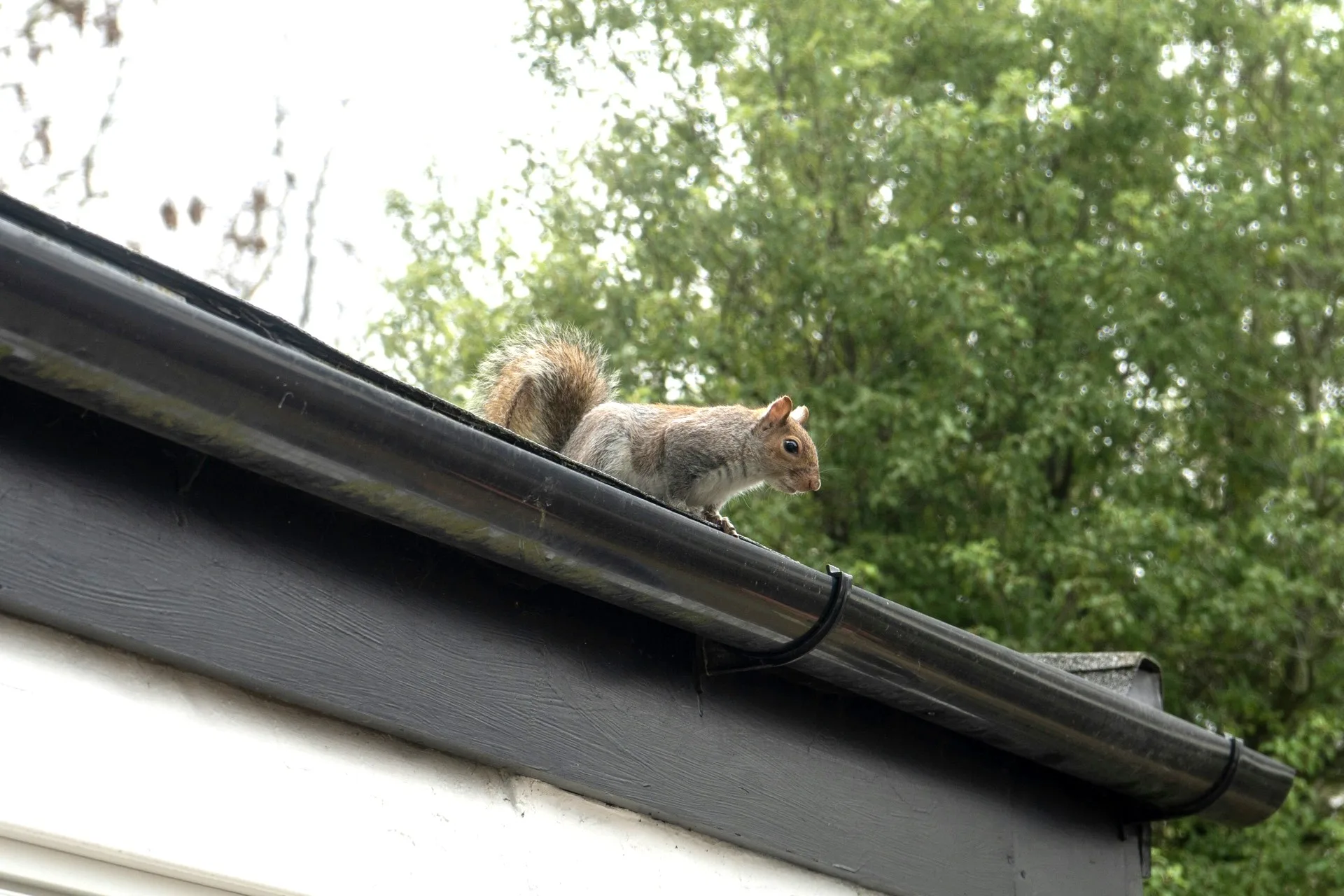
Gray vs. Fox Squirrels Across Georgia
Knowing which squirrel you're dealing with tells a Georgia contractor a lot about the job before the inspection even starts, and the species mix shifts with where you live in the state:
- Eastern gray squirrel — the default attic intruder across metro Atlanta and the Piedmont. Smaller and more agile, grays thrive wherever mature canopy bridges the gap to a roofline, which describes most of Georgia's older suburbs. They are responsible for the large majority of attic calls statewide.
- Fox squirrel — Georgia's largest tree squirrel, far more common in rural counties, pine-dominated stands, and the open Coastal Plain than in the dense metro core. A fox squirrel's size lets it widen an existing gable or soffit gap quickly, so rural-property jobs often involve bigger entry points and coarser damage.
- Southern flying squirrel — small, strictly nocturnal, and routinely mistaken for rats in older south-Georgia and intown housing. Because they are active at night and travel in colonies, a "rat in the attic" that scampers only after dark is frequently a flying-squirrel group instead — a misdiagnosis that wastes money on the wrong treatment.
A licensed Georgia trapper confirms the species first, because the right entry-hole size, exclusion-door type, and sealing approach all change depending on whether you have one agile gray, a heavy-bodied fox squirrel, or a colony of flyers.
Are Squirrels Protected in Georgia? Georgia DNR Rules & Permits
Gray and fox squirrels are classified as game animals in Georgia, not unprotected pests, with a regulated hunting season that runs roughly mid-August through the end of February and a daily bag limit. That status matters for homeowners in two ways. First, you generally can address squirrels actively damaging your own property, but Georgia DNR's Wildlife Resources Division regulates how it's done. Second — and this trips up most DIY attempts — relocating or releasing a trapped squirrel elsewhere typically requires a state permit; you cannot legally box one up and drop it at a park across town. Georgia also restricts squirrels (gray, fox, and flying) from being kept, so "catch and keep" is off the table too.
For that reason, Georgia law requires any company that traps, removes, or controls nuisance wildlife to hold a Nuisance Wildlife Control Operator (NWCO) permit from the DNR — a standard pest-control license is not enough. Every contractor in our directory holds the required Georgia credentials and works within DNR rules. One useful distinction from raccoons and bats: squirrels are not a rabies-vector species, so they don't carry the heavy rabies-protocol handling raccoons do — but the permitting, humane-method, and no-illegal-relocation rules still fully apply.
Georgia's Long Breeding Season — Why Intrusions Run Nearly Year-Round
In Georgia's climate, squirrels produce two litters a year, with newborns most common around February–March and again in July–August. Because the warm season is so long here, those cycles blur together and there is no true "off" period the way northern states get — which is exactly why Georgia attic-squirrel calls arrive in every month, not just one cold stretch. It also makes timing the eviction the critical skill on a Georgia job. Sealing a structure while a female is nursing a hidden litter walls the young inside, where they die and create an odor-and-fly callback within days. Georgia's most reliable gaps for safe one-way exclusion fall in late spring (after the first litter disperses) and mid-to-late fall (after the summer litter is mobile). Inspections and entry-point mapping can happen any time; only the sealing step has to be timed around the litters.
How Georgia Homes Let Squirrels In
Georgia's housing stock has a few recurring weak points that squirrels exploit, and they differ from the northern building types national guides tend to describe:
- Brick-ranch soffit returns and boxed eaves — extremely common in mid-century Atlanta, Macon, and Columbus suburbs, these corners loosen with age and give squirrels a sheltered chew point.
- Gable and ridge vents with thin or damaged screening — a standard roofline feature on Georgia homes and one of the most frequent true entry points.
- Construction gaps where dormers, additions, and rooflines meet — abundant in metro Atlanta's fast-built subdivisions, where two roof planes join imperfectly.
- Humidity-rotted fascia and wooden trim — Georgia's heat and moisture, especially in the Coastal Plain and around Savannah, soften wood faster, and a squirrel only needs a finger-width of soft fascia to start an opening.
- Mature-tree bridges — overhanging hardwood limbs across Georgia's tree-canopied lots are the highway onto the roof in the first place; trimming them back is part of any durable fix.
A squirrel needs an opening barely over an inch wide to get in, so a thorough Georgia inspection checks the entire roofline, not just the obvious hole.
What Drives Squirrel Removal Cost in Georgia
Statewide, most Georgia squirrel jobs land within the range shown below, but where you are in the state moves the number. Metro Atlanta tends to run a little higher — denser tree cover means more entry points per home and more competition for skilled, DNR-permitted operators — while rural and small-town Georgia jobs are often simpler single-entry trap-and-seal visits but can swing upward when a large fox squirrel has opened serious structural damage. The biggest cost drivers anywhere in Georgia are the number of entry points, whether a nesting female and litter are present, and how much chewed insulation, wood, or wiring has to be repaired after the animals are out. Reputable Georgia contractors quote after a property-specific inspection rather than over the phone.
Why It Pays to Act Fast in Georgia
Georgia's conditions reward quick action more than a cooler climate would. The near-continuous breeding season means a lone squirrel can become a nesting female with a litter in a matter of weeks, turning a simple eviction into a multi-animal exclusion. The state's heat and humidity also accelerate the damage — chewed openings let in moisture that rots framing and ruins insulation faster here than up north. And squirrels gnaw constantly to manage their teeth, so chewed electrical wiring (a recognized fire risk, particularly in Georgia's older Atlanta and Piedmont housing) becomes more likely the longer they stay. Getting a licensed Georgia pro out early keeps a roofline nuisance from becoming a structural and safety problem.
Squirrel Removal Cost in Georgia
$200–$500+
Trapping. Full exclusion and entry point sealing adds $300–$900+. Pricing varies by region, contractor, and severity. Each contractor in our directory provides free property-specific estimates.
Squirrel Removal by City in Georgia
Find a licensed local contractor in your city
- Acworth Squirrel Removal
- Adairsville Squirrel Removal
- Alpharetta Squirrel Removal
- Athens Squirrel Removal
- Atlanta Squirrel Removal
- Auburn Squirrel Removal
- Austell Squirrel Removal
- Barnesville Squirrel Removal
- Berkeley Lake Squirrel Removal
- Bloomingdale Squirrel Removal
- Bogart Squirrel Removal
- Bolingbroke Squirrel Removal
- Bonaire Squirrel Removal
- Bowdon Squirrel Removal
- Braswell Squirrel Removal
- Brooks Squirrel Removal
- Buford Squirrel Removal
- Byron Squirrel Removal
- Carrollton Squirrel Removal
- Cartersville Squirrel Removal
- Centerville Squirrel Removal
- Chattahoochee Hills Squirrel Removal
- Clarkdale Squirrel Removal
- College Park Squirrel Removal
- Dacula Squirrel Removal
- Dallas Squirrel Removal
- Douglasville Squirrel Removal
- Duluth Squirrel Removal
- East Point Squirrel Removal
- Emerson Squirrel Removal
- Euharlee Squirrel Removal
- Fairburn Squirrel Removal
- Fayetteville Squirrel Removal
- Flovilla Squirrel Removal
- Forsyth Squirrel Removal
- Fort Valley Squirrel Removal
- Garden City Squirrel Removal
- Grantville Squirrel Removal
- Grayson Squirrel Removal
- Griffin Squirrel Removal
- Hampton Squirrel Removal
- Hapeville Squirrel Removal
- Haralson Squirrel Removal
- Hiram Squirrel Removal
- Jackson Squirrel Removal
- Jenkinsburg Squirrel Removal
- Johns Creek Squirrel Removal
- Kathleen Squirrel Removal
- Kennesaw Squirrel Removal
- Kingston Squirrel Removal
- Knoxville Squirrel Removal
- Lawrenceville Squirrel Removal
- Lilburn Squirrel Removal
- Lithia Springs Squirrel Removal
- Locust Grove Squirrel Removal
- Loganville Squirrel Removal
- Mableton Squirrel Removal
- Macon Squirrel Removal
- Marietta Squirrel Removal
- McDonough Squirrel Removal
- Milner Squirrel Removal
- Milton Squirrel Removal
- Molena Squirrel Removal
- Monticello Squirrel Removal
- Moreland Squirrel Removal
- Mount Carmel Squirrel Removal
- Newnan Squirrel Removal
- Norcross Squirrel Removal
- Orchard Hill Squirrel Removal
- Palmetto Squirrel Removal
- Payne Squirrel Removal
- Peachtree City Squirrel Removal
- Peachtree Corners Squirrel Removal
- Perry Squirrel Removal
- Powder Springs Squirrel Removal
- Roberta Squirrel Removal
- Roswell Squirrel Removal
- Sandy Springs Squirrel Removal
- Savannah Squirrel Removal
- Senoia Squirrel Removal
- Shady Dale Squirrel Removal
- Sharpsburg Squirrel Removal
- Smyrna Squirrel Removal
- Snellville Squirrel Removal
- South Fulton Squirrel Removal
- Stockbridge Squirrel Removal
- Sugar Hill Squirrel Removal
- Sunny Side Squirrel Removal
- Suwanee Squirrel Removal
- Taylorsville Squirrel Removal
- Temple Squirrel Removal
- Thomaston Squirrel Removal
- Turin Squirrel Removal
- Tybee Island Squirrel Removal
- Tyrone Squirrel Removal
- Union City Squirrel Removal
- Villa Rica Squirrel Removal
- Vinings Squirrel Removal
- Warner Robins Squirrel Removal
- White Squirrel Removal
- Whitehall Squirrel Removal
- Williamson Squirrel Removal
- Winston Squirrel Removal
- Winterville Squirrel Removal
- Woolsey Squirrel Removal
- Yatesville Squirrel Removal
- Yorkville Squirrel Removal
- Zebulon Squirrel Removal
More Wildlife Services in Georgia
We handle every kind of wildlife problem across Georgia
Frequently Asked Questions — Squirrel Removal in Georgia
Looking for nationwide info? See our Squirrel Removal guide, or browse all wildlife removal in Georgia.