Squirrel Removal — Find a Licensed Local Trapper
Squirrels chew through wiring, insulation, and wood — creating fire hazards and structural damage inside your walls and attic.
Squirrel Removal in the United States
Eastern gray squirrels (Sciurus carolinensis) are the dominant residential nuisance squirrel across most of the United States. Twin breeding cycles per year — late winter and late summer — drive twin annual call peaks for attic intrusion. The dominant residential damage signature is chewed wood, chewed insulation, and chewed electrical wiring; chewed Romex is documented as a leading cause of attic-origin residential fires. Southern flying squirrels (Glaucomys volans) appear with notable frequency in older housing across the southeastern U.S. and are often mistaken for rats because of their nocturnal habits.
Squirrel Removal — Find Your Local Contractor
Click your state below to find the licensed contractor in your county.
Or browse by state below to find a verified local contractor.
Squirrel Removal Services Available
Squirrels chew electrical wiring which is a leading cause of house fires. Do not delay removal.
Warning Signs
Squirrels are most active in fall when stocking up for winter, and in early spring. They can enter homes any time of year.
- Scratching sounds in walls or attic
- Chewed wood or wires
- Droppings in attic
- Entry holes near roofline
- Nesting material in attic
What Professionals Do
Licensed contractors handle every aspect of squirrel removal — capture, exclusion, sanitation, repair.
- Live trapping
- One-way exclusion doors
- Entry point sealing with steel
- Attic insulation restoration
- Chewed wire assessment
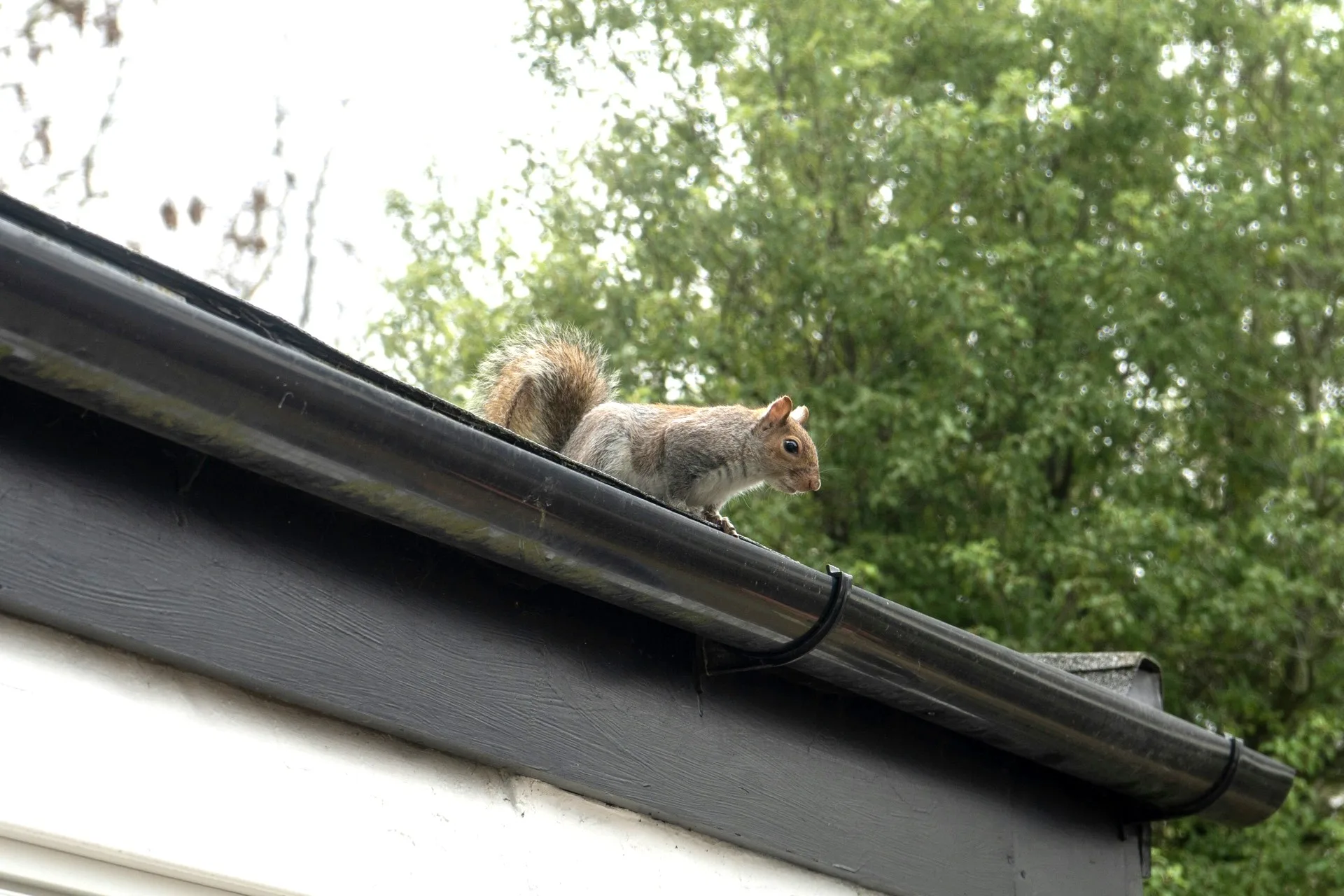
Squirrel Species You'll Find in U.S. Homes
The Eastern gray squirrel (Sciurus carolinensis) is the dominant residential nuisance squirrel across the eastern, midwestern, and southeastern United States. Adult body weight 1-1.5 lbs, daytime-active, distinctive bushy tail. Population densities are highest in suburban and urban areas with mature canopy and year-round food subsidy from bird feeders, garbage, and gardens. The Western gray squirrel (Sciurus griseus) is its Pacific Coast equivalent. Fox squirrels (Sciurus niger) are larger-bodied and present across much of the eastern U.S. Southern flying squirrels (Glaucomys volans) are smaller, nocturnal, gliding squirrels common in older housing across the southeastern U.S. — often mistaken for rats.
Signs You Have Squirrels
- Fast, light scratching from the ceiling at dawn and dusk — squirrels are diurnal, so peak activity is early morning and just before sunset
- Quick scampering bursts overhead during daylight hours
- Chewed wood at fascia, soffit corners, gable vents, and around utility-line penetrations
- Droppings in the attic — rice-grain-sized, often clustered in nesting areas
- Entry holes typically under 2 inches across — much smaller than raccoon openings
- Visible nest material (insulation, leaves, paper) bundled in the attic
- Chewed wiring or chewed Romex insulation — a serious fire risk
Why Chewed Wires Are a Fire Risk
Squirrels chew wires reflexively to keep their incisors filed down — they aren't targeting wiring specifically, but they don't distinguish between wiring and structural wood. Chewed Romex is documented as a leading cause of attic-origin residential fires. The risk is amplified in pre-1940 housing where wiring runs are 60-100+ years old (knob-and-tube remnants, early Romex with degraded insulation jacket, undersized neutral wires). Even modern Romex shows chew damage at cable, AC-line, and dryer-vent penetrations after squirrel entry. Any squirrel removal job that exposes chewed wiring requires licensed-electrician follow-up before final exclusion sealing, both for safety and to satisfy homeowners' insurance underwriters.
Squirrel Removal Cost — National Ranges
Most residential squirrel removal jobs in the U.S. run between $300 and $900+. Single-animal trap-and-release at one-entry-point newer homes sits at the low end. Multi-entry homes with chewed-wire repair and contaminated-insulation replacement run $1,200+ and up. Chewed-Romex repair triggers licensed-electrician follow-up cost on top. Pre-1940 historic-district homes with multiple entry points typically run higher than newer-construction subdivisions.
The Squirrel Eviction Calendar — Why Timing Matters
Eastern gray squirrels have two breeding cycles per year across most of the U.S.: a late-winter cycle producing kits February through April, and a late-summer cycle producing kits August through September. Performing one-way exclusion or trapping during nursing periods risks trapping kits inside wall cavities, where they die and cause smell-and-fly callbacks. The two safe exclusion windows are May through early June (after first-litter kits have dispersed) and October through November (after second-litter kits are mobile). Inspections and entry-point identification can happen any time of year; only the one-way-door exclusion step has to be timed precisely.
How Professional Squirrel Removal Works
A typical residential squirrel job: initial roofline inspection identifying all viable entry points (squirrels need only 1.5 inches); one-way exclusion doors deployed during the safe May-June or October-November windows; sealing all entry points with galvanized steel mesh; insulation removal and replacement where contamination is significant; licensed-electrician follow-up on any chewed wiring; long-term monitoring for re-entry. Most jobs run 7-14 days from first call to final exclusion.
Squirrel Removal Cost
$200–$500+
Trapping. Full exclusion and entry point sealing adds $300–$900+. Pricing varies by region, contractor, and severity. Each contractor in our directory provides free property-specific estimates.
Find a Licensed Squirrel Removal Contractor by State
Click your state to find the contractor serving your county.
- Alabama
- Alaska
- Arizona
- Arkansas
- California
- Colorado
- Connecticut
- Delaware
- District of Columbia
- Florida
- Georgia Squirrel Removal
- Hawaii
- Idaho
- Illinois
- Indiana
- Iowa
- Kansas
- Kentucky
- Louisiana
- Maine
- Maryland
- Massachusetts
- Michigan
- Minnesota
- Mississippi
- Missouri
- Montana
- Nebraska
- Nevada
- New Hampshire
- New Jersey
- New Mexico
- New York
- North Carolina
- North Dakota
- Ohio
- Oklahoma
- Oregon
- Pennsylvania
- Rhode Island
- South Carolina
- South Dakota
- Tennessee
- Texas
- Utah
- Vermont
- Virginia
- Washington
- West Virginia
- Wisconsin
- Wyoming