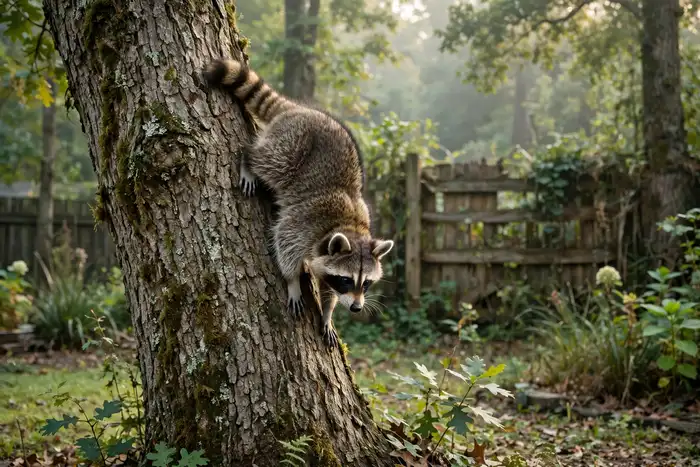
Northern raccoons (Procyon lotor) are one of the highest-volume residential call sources across Davidson County's wildlife removal market — driven by a uniquely Nashville combination of pre-1900s brick housing stock in East Nashville and Germantown, mature oak-hickory canopy across Belle Meade, Forest Hills, Hillsboro Village, Belmont, and 12 South, the Cumberland River corridor cutting through the heart of the city, and a dense urban food supply that runs from Lower Broadway dumpsters out through every food-service block in the Nations, the Gulch, and Music Row. Davidson's combination of year-round mild winters, the city's extensive greenway-and-stormwater pond network, and an architecturally varied housing stock with abundant tree-to-roof access makes it the highest raccoon-pressure jurisdiction in middle Tennessee on a per-square-mile basis.
Signs
How you know it’s raccoons
Our crew checks for the same pattern of evidence on nearly every Joelton call, and you can spot much of it yourself. Look for the following around your roofline, attic, and crawl space before you call us.
- Footprints in mud or soft soil
- Noises in attic at night
- Knocked over trash cans
- Torn soffit or fascia boards
- Droppings near entry points
Pay attention to timing when you check these signs in Joelton. Fresh droppings, damp staining and strong odor mean raccoons are active now; dry, grey sign usually means an older visit — though old routes get reused every season.
Seasonal Patterns That Drive Davidson Raccoon Calls
Raccoon call volume in Davidson follows a predictable annual cycle. January through March is mating season — homeowners report fighting noises overhead, increased nighttime activity, and the first wave of attic intrusions as adult females scout den sites in pre-1920s brick housing. March through May is birth season, when females settle into chimneys, attics, and shed crawlspaces to whelp; this is when emergency removal calls peak across the East Nashville, Germantown, and Belle Meade housing stock, often involving 2-5 kits along with the mother. May through August is kit-rearing season — most exclusion work in Davidson happens here, because doing exclusion any earlier risks separating a mother from dependent kits and trapping the kits inside the structure. September through November is dispersal, when juveniles strike out for new territory and a fresh wave of younger animals tests entry points across the consolidated city. December through February is winter denning, with multiple raccoons (sometimes 3-5) occasionally sharing a single attic or chimney for warmth in older East Nashville, Germantown, and Belle Meade housing stock.
Health and Safety Risks From Davidson County Raccoons
Tennessee is a rabies-endemic state with skunk and bat rabies the dominant variants in middle Tennessee, but raccoons are also a recognized rabies vector and the most common large-mammal carrier nationwide. Any Davidson resident bitten or scratched by a raccoon should contact Metro Nashville Animal Care and Control and the Tennessee Department of Health immediately and not attempt to handle or release the animal. Beyond rabies, raccoon roundworm (Baylisascaris procyonis) is present in Davidson raccoon feces and is genuinely dangerous to humans and pets — particularly children who might come into contact with attic insulation contaminated by an infestation. Leptospirosis is transmitted through raccoon urine, including dried urine in attic dust. Canine distemper is fatal to unvaccinated dogs and can spread from raccoon contact. On the property side, raccoons in attics typically destroy 20-40% of the affected insulation, gnaw HVAC ductwork — a real problem in the 1990s-2000s construction across Donelson, Antioch, and Bellevue where ducts run through unconditioned attic space — and chew electrical wiring, a fire risk that homeowners' insurance underwriters take seriously.
Tennessee Wildlife Regulations That Apply to Raccoon Removal in Davidson County
Raccoons in Tennessee are managed by the Tennessee Wildlife Resources Agency (TWRA) under both furbearer and nuisance classifications. Commercial removal requires a TWRA Nuisance Wildlife Control Operator (NWCO) certification, and species-specific handling and disposition rules apply. Davidson falls under TWRA Region II, headquartered at the Nashville office in the same county. Property owners may handle nuisance raccoons on their own property under specific conditions outlined in state regulations, but relocating live-trapped raccoons off-property is restricted under TWRA disease-management rules, and lethal control must comply with state regulations. The Metropolitan Government of Nashville and Davidson County maintains its own municipal codes affecting trapping and firearm discharge inside the consolidated city limits, and the satellite cities of Belle Meade, Berry Hill, Forest Hills, Oak Hill, and Goodlettsville maintain additional codes on top of Metro's. Historic-overlay districts in Edgefield (East Nashville), Germantown, and Music Row require Metro Historic Zoning Commission coordination for visible structural changes during exclusion. Our operators hold the applicable state credentials.
Southeastern raccoons are active year-round due to the mild climate, with the highest call volumes in late winter denning season and again in summer when juveniles disperse. Raccoon roundworm (Baylisascaris procyonis) is a documented public health concern in the region, making professional attic remediation after removal essential.
Field notes — Davidson County
Nashville sits in the Cumberland River basin, the river looping through the city with wooded ridges west and south. Creek corridors and bottomland thread through otherwise dense urban ground.
The county mixes dense urban blocks and older pre-war neighborhoods with aging inner-ring suburbs and newer infill. Older attics, chimneys, and crawl spaces are common entry terrain across the established residential core.
Big brown bats and raccoons are the signature attic pressure in older Nashville housing, working chimneys and rooflines along the river corridors. Rats follow dense commercial ground, and squirrels use the mature street canopy for roof access.
Joelton sits in Davidson County, whose county seat is Nashville. Our crew covers the whole county — including Berry Hill, Donelson, Forest Hills — so if the problem turns out to be at a second property nearby, one call still covers it.
The work
How we get raccoons out of a Joelton home
The method depends on what we find in your Joelton home. A single animal near one entry is a different job from a colony spread through the attic, and we will explain which approach fits — and why — before any equipment comes out.
- Preventative exclusion
- Live trapping and removal
- Attic cleanup and decontamination
- Entry point sealing
- Damage repair
Around Davidson County, that usually means older and newer homes fail in different places — old chimneys and soffits on one street, builder-grade vents and garage corners on the next. In Joelton, we adjust the inspection to the age and style of your house.
No two Joelton homes take exactly the same fix, which is why we finish with recommendations specific to your roof, your lot, and your trees. Call us and describe the signs, and we will tell you honestly what we would do first.
Don’t wait on it
Why raccoons get more expensive
Raccoons breed in attics and their feces carry dangerous roundworm spores.
Neighbors are part of the math too. Raccoons excluded from one Joelton attic usually test the houses on either side within the week — getting yours sealed early is both a fix and a warning worth passing along the street.
The biggest risk of waiting through a breeding season in Joelton is simple arithmetic. One female raccoon becomes a litter raised in your attic, and a litter becomes several animals using several entry points by the time they leave — if they leave.
Cost
What raccoon removal runs in Joelton
Homeowners in Joelton understandably want a number before they call, so use the ranges below as planning guidance only — not a quote. Your actual cost depends on entry points, cleanup, and how long raccoons have been inside, which we confirm on site.
| Job | Typical range |
|---|
| Raccoon Removal — typical Joelton job | $200–$600+ |
General guidance from typical Tennessee work — not a quote. Your price is set after we inspect your home, before work starts. See our guides for how pricing breaks down.
RemoveWildlifeNow
Raccoon in Joelton — handled today
(844) 544-3498
Call us and tell us what you're hearing, seeing or smelling — we'll take it from there. The animals come out, the entry points get sealed, and the mess gets cleaned up.
- Licensed & insured
- Same-day service
- Open 24/7
- Humane methods
Raccoon questions from Joelton homeowners
How much does raccoon removal cost in Joelton, Tennessee?
Raccoon removal in Tennessee typically costs $200–$600+ for trapping and removal. If raccoons have been living in your attic, full remediation including cleanup, decontamination, and entry point sealing generally runs $800–$2,500+ depending on colony size and insulation damage. Call for an estimate specific to your Joelton property.
Does homeowners insurance cover raccoon damage in Tennessee?
Some Tennessee homeowners insurance policies cover sudden, accidental raccoon damage — such as a torn soffit or damaged roof decking. Most policies do not cover gradual damage or the cost of removal itself. Review your policy or call your agent before assuming coverage. Your Joelton contractor can provide documentation of damage for insurance claims.
Are raccoons dangerous to my family in Joelton?
Yes. Raccoons in Tennessee are one of the primary wildlife carriers of rabies and shed Baylisascaris roundworm in their feces — a parasite that can be fatal to humans and pets. Attic-dwelling raccoons contaminate insulation with droppings that remain infectious long after the animals are gone. Professional cleanup after removal is not optional — it is a health necessity.
What time of year are raccoons worst in Tennessee?
Raccoons are worst in Tennessee from December through March, when pregnant females actively seek attic entry points to give birth. A second wave of activity occurs in late summer as juveniles disperse and establish new territories. Joelton residents should inspect rooflines and soffits in fall — before denning season — to seal entry points before a raccoon moves in.
How do I handle a copperhead at my Belle Meade or Radnor-area property?
Copperhead encounters are routine in the wooded properties of Belle Meade, Forest Hills, Oak Hill, the Radnor Lake and Warner Parks bluff edges, the Bells Bend and Bellevue hillsides, and the Beaman Park-adjacent Joelton properties — terrain that produces the rocky, brushy habitat copperheads use. Stay back, keep pets and children well away, and call a licensed wildlife contractor for identification and removal. The Eastern rat snake is by far the most frequently mis-identified non-venomous species in this county and accounts for many calls that turn out to be harmless. A licensed contractor will identify the species before handling. If a bite has occurred, treat it as a medical emergency — call 911 and get to a hospital with antivenom availability. Do not attempt cut-and-suck treatments, tourniquets, or self-relocation.
Is wildlife removal regulated in Davidson County?
Yes. Wildlife removal in Davidson County operates under three layers of regulation. State-level oversight comes from the Tennessee Wildlife Resources Agency (TWRA) Region II, Nashville office (headquartered in Davidson County), which administers the Nuisance Wildlife Control Operator (NWCO) certification required for commercial operators and enforces species-specific handling and disposition rules. Federal protections apply to bats, all migratory birds (Canada geese, owls, hawks, woodpeckers, herons), the federally endangered Nashville crayfish in the Mill Creek system, the federally listed bats and mussels in the Cumberland system, and bald eagles at Old Hickory and Percy Priest Lakes. The Metropolitan Government of Nashville and Davidson County maintains its own municipal codes affecting trapping, firearm discharge, and rodenticide use inside the consolidated city limits, and the satellite cities of Belle Meade, Berry Hill, Forest Hills, Oak Hill, and Goodlettsville maintain additional municipal codes that apply on top of Metro's. Historic-overlay districts in East Nashville, Germantown, Edgefield, and Music Row require coordination with Metro Historic Zoning Commission review for visible structural changes during exclusion work. Metro Nashville Animal Care and Control handles domestic-animal calls but does not respond to most nuisance wildlife — those calls are referred to licensed private operators. Our operators hold the applicable state and federal credentials.
Other animals in Joelton