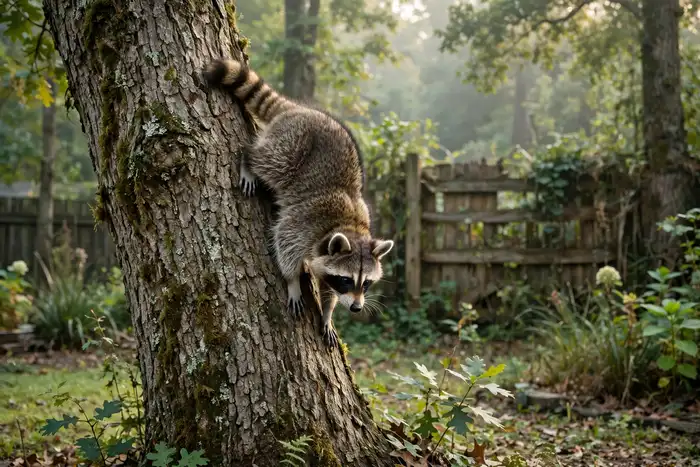
Northern raccoons (Procyon lotor) are one of the highest-volume residential call sources across Davidson County's wildlife removal market — driven by a uniquely Nashville combination of pre-1900s brick housing stock in East Nashville and Germantown, mature oak-hickory canopy across Belle Meade, Forest Hills, Hillsboro Village, Belmont, and 12 South, the Cumberland River corridor cutting through the heart of the city, and a dense urban food supply that runs from Lower Broadway dumpsters out through every food-service block in the Nations, the Gulch, and Music Row. Davidson's combination of year-round mild winters, the city's extensive greenway-and-stormwater pond network, and an architecturally varied housing stock with abundant tree-to-roof access makes it the highest raccoon-pressure jurisdiction in middle Tennessee on a per-square-mile basis.
Signs
How you know it’s raccoons
Most Donelson homeowners notice one sign and miss the rest, because raccoons are quiet tenants during the day. Check the full list below, especially around vents, soffits, and the chimney, and note anything that looks fresh or recently disturbed.
- Knocked over trash cans
- Torn soffit or fascia boards
- Droppings near entry points
- Footprints in mud or soft soil
- Noises in attic at night
Check the quiet corners first: behind the chimney, above the bathroom fan, along the eaves where the insulation meets the roof deck. In Davidson County homes, raccoons settle where it is darkest and least disturbed.
Raccoons in Davidson County Neighborhoods
Raccoon activity isn't uniform across Metro Nashville. The job mix on a Tuesday in East Nashville looks different from a Tuesday in Bellevue or Hermitage, and that pattern has held steady for years.
East Nashville (Edgefield, Lockeland Springs, Inglewood, Five Points, East End, Riverside)
Pre-1920s brick and shotgun housing stock with original wood soffits, decayed parapet walls on the older commercial structures, deteriorated chimney mortar, and decades of unmaintained gable louvers. Multi-entry-point attic infestations are the dominant call type here — five to ten viable entries per home is the norm rather than the exception, and chimney denning during winter months is consistent across the historic core. The Five Points, East End, and Riverside food-service blocks add dumpster-driven exterior pressure that pushes raccoons into adjacent residential properties.
Germantown and the historic downtown core
This is some of the oldest housing in the consolidated city, and the entry-point profile is unique. Brick chimneys with deteriorated mortar, original slate or tile roofs with gaps at flashing, attic crawl access through pre-war architectural features, and Mexican free-tailed bat colonies sometimes occupying the same structural cavities raccoons use. Germantown historic homes routinely have 5+ viable raccoon entry points and require structural exclusion that goes well beyond standard new-construction sealing. Any structural work in the Germantown historic district, the Edgefield overlay in East Nashville, or the Music Row historic commercial district may require coordination with Metro Historic Zoning Commission review.
Belle Meade, Forest Hills, Oak Hill, Green Hills, and the affluent old-canopy estates
Mature canopy, large lots, and 1940s-1990s housing stock with substantial wood trim, dormers, and complex rooflines — the same architectural profile that makes these neighborhoods desirable also makes them raccoon-prone. Attic infestations and chimney denning dominate the call mix, often with 2-5 viable entry points per home. The Warner Parks and Radnor Lake bluff edges push wildlife directly into the surrounding residential blocks year-round.
Donelson, Hermitage, and the Percy Priest corridor
Mid-century ranch and split-level subdivisions with the J. Percy Priest Lake shoreline forming the eastern edge of the call territory. Raccoon calls here often come bundled with beaver flooding or coyote sightings on the same property — the wildlife-corridor pressure from Stones River and the smaller Percy Priest tributaries is real. The Hermitage historic site (Andrew Jackson's plantation) adds a layer of low-density wooded habitat that pushes raccoons into surrounding subdivisions.
Antioch, Crieve Hall, and the Mill Creek corridor
Mid-century and 1990s-2000s subdivisions with the Mill Creek system threading directly through the call territory. Raccoon calls here often co-locate with beaver flooding, snake calls, and the occasional Nashville crayfish encounter — Mill Creek is the only documented habitat in the world for the federally endangered Nashville crayfish, so any in-stream or bank work along the creek is subject to direct U.S. Fish & Wildlife Service consultation regardless of the species being trapped.
Bellevue, Bells Bend, and the rural west Davidson edge
Larger acreage, equestrian properties on the rural Cumberland meander, detached barns and outbuildings, and a higher proportion of damage to feed rooms, tack rooms, and chicken coops. Raccoons here often present as predation calls on backyard poultry and feed-room contamination rather than attic intrusions, though attic and outbuilding denning is also routine. Multiple-entry-point exclusion on barn and outbuilding structures is the norm.
Seasonal Patterns That Drive Davidson Raccoon Calls
Raccoon call volume in Davidson follows a predictable annual cycle. January through March is mating season — homeowners report fighting noises overhead, increased nighttime activity, and the first wave of attic intrusions as adult females scout den sites in pre-1920s brick housing. March through May is birth season, when females settle into chimneys, attics, and shed crawlspaces to whelp; this is when emergency removal calls peak across the East Nashville, Germantown, and Belle Meade housing stock, often involving 2-5 kits along with the mother. May through August is kit-rearing season — most exclusion work in Davidson happens here, because doing exclusion any earlier risks separating a mother from dependent kits and trapping the kits inside the structure. September through November is dispersal, when juveniles strike out for new territory and a fresh wave of younger animals tests entry points across the consolidated city. December through February is winter denning, with multiple raccoons (sometimes 3-5) occasionally sharing a single attic or chimney for warmth in older East Nashville, Germantown, and Belle Meade housing stock.
Health and Safety Risks From Davidson County Raccoons
Tennessee is a rabies-endemic state with skunk and bat rabies the dominant variants in middle Tennessee, but raccoons are also a recognized rabies vector and the most common large-mammal carrier nationwide. Any Davidson resident bitten or scratched by a raccoon should contact Metro Nashville Animal Care and Control and the Tennessee Department of Health immediately and not attempt to handle or release the animal. Beyond rabies, raccoon roundworm (Baylisascaris procyonis) is present in Davidson raccoon feces and is genuinely dangerous to humans and pets — particularly children who might come into contact with attic insulation contaminated by an infestation. Leptospirosis is transmitted through raccoon urine, including dried urine in attic dust. Canine distemper is fatal to unvaccinated dogs and can spread from raccoon contact. On the property side, raccoons in attics typically destroy 20-40% of the affected insulation, gnaw HVAC ductwork — a real problem in the 1990s-2000s construction across Donelson, Antioch, and Bellevue where ducts run through unconditioned attic space — and chew electrical wiring, a fire risk that homeowners' insurance underwriters take seriously.
Southeastern raccoons are active year-round due to the mild climate, with the highest call volumes in late winter denning season and again in summer when juveniles disperse. Raccoon roundworm (Baylisascaris procyonis) is a documented public health concern in the region, making professional attic remediation after removal essential.
Field notes — Davidson County
Nashville sits in the Cumberland River basin, the river looping through the city with wooded ridges west and south. Creek corridors and bottomland thread through otherwise dense urban ground.
The county mixes dense urban blocks and older pre-war neighborhoods with aging inner-ring suburbs and newer infill. Older attics, chimneys, and crawl spaces are common entry terrain across the established residential core.
Big brown bats and raccoons are the signature attic pressure in older Nashville housing, working chimneys and rooflines along the river corridors. Rats follow dense commercial ground, and squirrels use the mature street canopy for roof access.
Around Donelson
Neighbourhoods we work: Stones River bottomland neighborhoods · the Old Lebanon Dirt Road / Donelson Hills area · Cumberland River bluff homes near Two Rivers · Donelson core / Lebanon Pike corridor · Two Rivers Park and the Stones River Greenway corridor
Donelson is one of the most uniform mid-century-ranch communities in Davidson County, built out heavily in the 1950s-1970s as Nashville expanded east of downtown toward the airport. The dominant fabric is single-story brick-veneer and frame ranch and split-level homes with low-slope and gabled asphalt-shingle roofs, original brick chimneys, deep soffit-and-fascia returns, attic-fan housings, gable-vent louvers, and the deck-pier-and-skirting crawlspace profile typical of the era — a housing stock that carries some of the highest single-home entry-point counts the contractor sees anywhere in the metro.
Donelson Animal Control vs. Private Wildlife Removal — Who to Call
A common Donelson mistake is calling municipal animal control about an animal in the attic and waiting on a response that is not coming — government animal services here handle domestic-animal complaints, not wildlife inside the structure. Matching the problem to the right contact saves time:
- Domestic-animal issues (stray dog, cat bite, leash complaint) — Metro Nashville Animal Care & Control. Free.
- Injured or orphaned native wildlife (a goose tangled in line at Two Rivers, a fallen baby bird, a sick raccoon) — a TWRA-permitted wildlife rehabilitator. Free or donation-based.
- Rabies exposure or a bat in a bedroom (any bite or scratch from a wild mammal, or a bat found where someone was sleeping) — Metro Public Health Department and your physician or veterinarian; do not release the animal until rabies testing is sorted out. Insurance-billed.
- Nuisance wildlife removal and exclusion (raccoons in the chimney, bats in the attic, squirrels chewing wiring, snakes in the yard, Canada geese on the pond, armadillos in the lawn) — a licensed private wildlife contractor. Paid service.
Donelson sits just east of downtown Nashville, wrapped on two sides by water and woods: the Stones River and J. Percy Priest Lake form its eastern and southern boundary, and Two Rivers Park — where the Stones River meets the Cumberland — anchors the community's northern edge with a large block of bottomland hardwood, open meadow, and greenway. That geography puts a continuous riparian and lake-edge wildlife corridor directly against the residential blocks, moving raccoons, opossums, beavers, river otters, white-tailed deer, coyotes, snakes, Canada geese, and an expanding armadillo population through the neighborhoods year-round. Nashville International Airport (BNA) and the Briley Parkway and I-40 corridors that ring Donelson add tree-buffer travel routes and large open grassland edges that further shape the local species mix — the airport-area retention ponds and open turf in particular drive the heaviest Canada goose nuisance pressure in this part of the county. The result is steady, water-driven wildlife pressure on Donelson homes from the river and lake side and a mid-century housing stock unusually well suited to letting it indoors.
That housing stock is the second half of the story. Donelson is one of the most uniform 1950s-1970s mid-century ranch communities in Davidson County, and the era's construction details read like a wildlife-entry checklist: deep soffit-and-fascia returns that separate at the corners, original uncapped brick chimneys, gable-vent louvers without screen backing, attic-fan housings, and the deck-pier-and-skirting crawlspace cavities that make near-perfect dens. These homes carry some of the highest single-home entry-point counts in the metro, which is why DIY sealing rarely holds — a typical Donelson raccoon or squirrel job involves several viable entries, not one. The smaller pocket of pre-war and early-1950s housing near the original Donelson core and along Lebanon Pike carries the heaviest raccoon-and-bat profile, and the scattered 1980s-2000s infill and ongoing teardown-and-rebuild construction near the river and lake add a newer-construction entry vocabulary of gable-vent screens, ridge-vent pull-throughs, and HVAC penetrations.
Across Donelson, raccoons are the number-one call species, with attic and chimney intrusions heaviest from January through May during denning and kit season — the original brick chimneys of the mid-century ranch belt are the first sites to see activity. Eastern gray squirrels are a high-volume year-round call wherever mature canopy reaches the roofline, and southern flying squirrels turn up as a quiet, underdiagnosed attic occupant in the wooded blocks near Two Rivers Park and the Stones River. Bats — big brown and evening bats — form maternity colonies in the older Lebanon Pike-corridor chimneys; bats are protected and their exclusion is timing-regulated by the state, so this work is scheduled around the maternity season. Canada geese are the standout nuisance-bird call here, concentrated on the airport-edge and corporate-park retention ponds and the Percy Priest Lake-adjacent open turf. Coyotes are established along the Stones River, the lake shoreline, and the Two Rivers greenway; beavers and the occasional river otter generate flooding and shoreline calls along the river corridor; snakes — rat snakes routinely and copperheads in the wooded and rocky lots — are removed each spring and fall; and armadillos now root the irrigated lawns through the warmer months.
Donelson sits in Davidson County, whose county seat is Nashville. Our crew covers the whole county — including Oak Hill, Old Hickory, Whites Creek — so if the problem turns out to be at a second property nearby, one call still covers it.
The work
How we get raccoons out of a Donelson home
Expect us to show you what we find as we go — entry points, damage, the evidence for how long raccoons have been inside your Donelson home. You should never have to take the scope of the work on faith.
- Attic cleanup and decontamination
- Entry point sealing
- Damage repair
- Preventative exclusion
- Live trapping and removal
Around Davidson County, that usually means entry points cluster where the house meets the landscape: low rooflines under canopy, decks over crawl spaces, and chimneys on older homes. Our crew in Donelson starts at those junctions because that is where raccoons test first.
Once the steps above are done, we walk the property with you and show you exactly what was closed and why. If anything new turns up in the days after, call us and tell us what you are hearing — we would rather hear early.
Don’t wait on it
Why raccoons get more expensive
Fast removal is essential.
Finally, the entry itself is a weather problem. Every opening raccoons use in a Donelson roofline is also a path for rain, and attic moisture plus contaminated insulation is how a wildlife call turns into a carpentry bill.
An entry point used by raccoons does not stay the same size. Claws, weather, and repeated use widen it, rain follows the same path into the attic, and other wildlife in Davidson County — insects included — find the opening too. Early action keeps the fix small.
Cost
What raccoon removal runs in Donelson
Think of the costs below as a realistic local range for Donelson, not a promise. When you call us, tell us the signs and the size of the home, and we will explain which end of the range your situation most likely falls on, and why.
| Job | Typical range |
|---|
| Raccoon Removal — typical Donelson job | $200–$600+ |
General guidance from typical Tennessee work — not a quote. Your price is set after we inspect your home, before work starts. See our guides for how pricing breaks down.
RemoveWildlifeNow
Raccoon in Donelson — handled today
(844) 544-3498
Call us and tell us what you're hearing, seeing or smelling — we'll take it from there. The animals come out, the entry points get sealed, and the mess gets cleaned up.
- Licensed & insured
- Same-day service
- Open 24/7
- Humane methods
Raccoon questions from Donelson homeowners
Are raccoons dangerous to my family in Donelson?
Yes. Raccoons in Tennessee are one of the primary wildlife carriers of rabies and shed Baylisascaris roundworm in their feces — a parasite that can be fatal to humans and pets. Attic-dwelling raccoons contaminate insulation with droppings that remain infectious long after the animals are gone. Professional cleanup after removal is not optional — it is a health necessity.
What time of year are raccoons worst in Tennessee?
Raccoons are worst in Tennessee from December through March, when pregnant females actively seek attic entry points to give birth. A second wave of activity occurs in late summer as juveniles disperse and establish new territories. Donelson residents should inspect rooflines and soffits in fall — before denning season — to seal entry points before a raccoon moves in.
Can I remove raccoons myself in Tennessee?
Raccoon removal requires a state permit in Tennessee, which is issued through the Tennessee Wildlife Resources Agency. Handling raccoons without proper equipment and licensing carries serious legal and health risks. Licensed contractors in Donelson hold the required permits and carry the equipment needed to remove raccoons safely, handle them legally under the state's rabies-vector rules, and clean contaminated areas properly.
How much does raccoon removal cost in Donelson, Tennessee?
Raccoon removal in Tennessee typically costs $200–$600+ for trapping and removal. If raccoons have been living in your attic, full remediation including cleanup, decontamination, and entry point sealing generally runs $800–$2,500+ depending on colony size and insulation damage. Call for an estimate specific to your Donelson property.
How serious is the rat problem in Nashville and East Nashville?
Davidson County carries the heaviest urban rat pressure in middle Tennessee. Norway rats are concentrated along Lower Broadway, the Gulch, Germantown, the East Nashville food-service blocks (Five Points, East End, Riverside), Music Row, and the Hillsboro Village, 12 South, and Nations corridors — driven by burrow systems in the alley-and-dumpster gaps behind restaurants and bars, the dense pre-1900s sewer infrastructure beneath downtown and the older commercial neighborhoods, and the river-corridor and storm-detention pond networks. Effective control is rarely a single visit — it requires bait-station systems coordinated across adjacent properties, structural sealing of foundation gaps and utility penetrations, and exterior pressure reduction from neighboring food-source properties. Roof rats are increasingly documented in some of the same blocks and require a different baiting and exclusion approach because they nest in elevated voids rather than in burrows. A licensed contractor will scope the property, the neighboring blocks, and the city infrastructure draws before quoting a sustainable-control plan.
What should I do about bats in my East Nashville or Germantown attic?
Don't try to handle a bat colony yourself. Bats in Tennessee carry rabies risk, are protected by state and federal regulations during the maternity period, and require specialized exclusion technique to remove without sealing pups inside the structure. Davidson's pre-1920s housing stock — East Nashville (Edgefield, Lockeland Springs, Inglewood), Germantown, the Belmont-Hillsboro and Music Row historic districts, and the original Belle Meade and Forest Hills estates — is the classic substrate for big brown bat and Mexican free-tailed bat maternity colonies forming in louvered gable vents and original wood-shake or slate roofing. Mexican free-tailed bat colonies in larger commercial structures (downtown, Music City Center, older Donelson and Madison commercial blocks) can produce substantial guano accumulation that requires HEPA-equipped decontamination after exclusion. TWRA restricts active exclusion during the maternity period (roughly mid-May through early August) to protect non-volant pups. A licensed contractor will typically schedule work for August through April, install one-way exit devices, and seal the structure once the colony has been confirmed to have left. Davidson's older brick housing also tends to require multi-point exclusion (five to ten or more sealed entries per property) rather than a single-point repair.
Other animals in Donelson