Signs
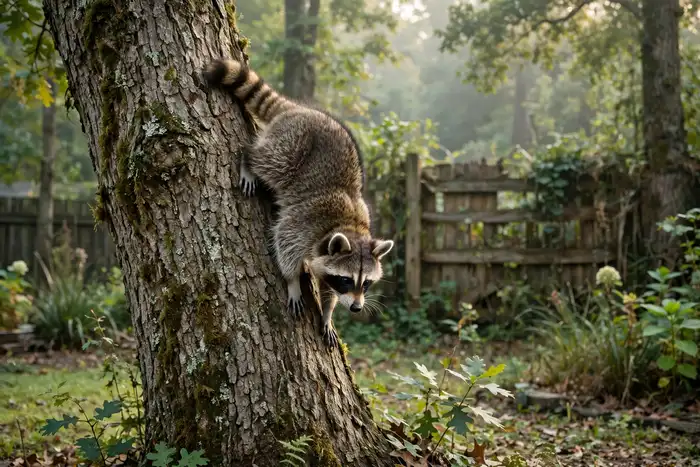
How you know it’s raccoons
Tell us which of these you are seeing when you call — it helps us arrive with the right equipment and a clear plan. These are the signs that separate a passing raccoon from one that has moved into a Doylestown home.
- Noises in attic at night
- Knocked over trash cans
- Torn soffit or fascia boards
- Droppings near entry points
- Footprints in mud or soft soil
Check the quiet corners first: behind the chimney, above the bathroom fan, along the eaves where the insulation meets the roof deck. In Bucks County homes, raccoons settle where it is darkest and least disturbed.
Raccoons in the Northeast have become highly urbanized over decades, learning to exploit chimneys, open soffits, and loose roof flashing as denning sites. Attic intrusions in this region often involve nursing females in late winter, requiring exclusion to be timed after young are fully mobile — typically by mid-May.
Field notes — Bucks County
The Delaware River and canal form the eastern edge, Lake Nockamixon anchors the north, and Neshaminy Creek drains the center.
Levittown's 1950s sections fill the south, historic boroughs and horse farms the center, and wooded river-hill communities the north.
Gray squirrels and raccoons dominate from Levittown to Doylestown, groundhogs hold the central farm edges, and the creek and river corridors move skunks through every township.
Around Doylestown
Neighbourhoods we work: Plumstead border (streets north toward the river hills) · Warrington border (suburban streets south) · Fonthill area (homes near the Mercer castle grounds) · Borough center (Victorian blocks near the courthouse) · Doylestown Township (suburbs around the borough)
Doylestown pairs a Victorian county-seat borough — brick and stone homes around the courthouse — with Doylestown Township's postwar and newer colonials and Buckingham's farm-edge large lots.
Pine Run and Neshaminy tributaries (creek corridors through the township), Fonthill and Mercer Museum grounds (wooded castle parkland in the borough), Peace Valley Park (lake park a few miles west)
Timing matters in Doylestown. Raccoon litters arrive in chimneys and attics in spring, bat colonies raise young in the older rooflines through summer — with exclusions held, per Pennsylvania Game Commission guidance, outside the May 15 through August 1 maternity window — and squirrels and rodents make their big push indoors in fall. Even the quiet months are not quiet: overwintering bats wake on warm winter nights, and rats never take a season off in the older districts. Our crew times the work to the animal and the season, removes what is in the structure, and seals every entry we find.
Doylestown's calls split borough and country: raccoons and bats in the borough's Victorian housing, squirrels across the township suburbs, and groundhogs along the Buckingham and Plumstead farm edges. Skunks work the lawns around Peace Valley and the creek corridors at dusk. Borough Victorians and farm-edge properties both appear in a week's calls here; our crew inspects outbuildings on the larger lots as a matter of routine.
Doylestown sits in Bucks County. Our crew covers the whole county — including Warminster, Levittown, Bensalem — so if the problem turns out to be at a second property nearby, one call still covers it.
The work
How we get raccoons out of a Doylestown home
Expect us to show you what we find as we go — entry points, damage, the evidence for how long raccoons have been inside your Doylestown home. You should never have to take the scope of the work on faith.
- Damage repair
- Preventative exclusion
- Live trapping and removal
- Attic cleanup and decontamination
- Entry point sealing
Around Bucks County, that usually means entry points cluster where the house meets the landscape: low rooflines under canopy, decks over crawl spaces, and chimneys on older homes. Our crew in Doylestown starts at those junctions because that is where raccoons test first.
The goal is not just an empty attic this week — it is a house raccoons cannot re-enter next season. If you are hearing noises or seeing signs in Doylestown, call us now so we can get ahead of it while the work is still straightforward.
Don’t wait on it
Why raccoons get more expensive
Fast removal is essential.
Finally, the entry itself is a weather problem. Every opening raccoons use in a Doylestown roofline is also a path for rain, and attic moisture plus contaminated insulation is how a wildlife call turns into a carpentry bill.
Contamination is the part homeowners in Doylestown underestimate most. Droppings accumulate fast, they can carry parasites and bacteria, and every day raccoons remain overhead adds to what has to be removed, disinfected, and sealed out for good.
Cost
What raccoon removal runs in Doylestown
We price raccoon work in Bucks County after we see the house, because a single entry point and a season of contamination are very different jobs. The figures below reflect typical ranges we see locally, shared so you can plan rather than guess.
| Job | Typical range |
|---|
| Raccoon Removal — typical Doylestown job | $200–$600+ |
General guidance from typical Pennsylvania work — not a quote. Your price is set after we inspect your home, before work starts. See our guides for how pricing breaks down.
RemoveWildlifeNow
Raccoon in Doylestown — handled today
(844) 544-3498
Call us and tell us what you're hearing, seeing or smelling — we'll take it from there. The animals come out, the entry points get sealed, and the mess gets cleaned up.
- Licensed & insured
- Same-day service
- Open 24/7
- Humane methods
Raccoon questions from Doylestown homeowners
Does homeowners insurance cover raccoon damage in Pennsylvania?
Some Pennsylvania homeowners insurance policies cover sudden, accidental raccoon damage — such as a torn soffit or damaged roof decking. Most policies do not cover gradual damage or the cost of removal itself. Review your policy or call your agent before assuming coverage. Your Doylestown contractor can provide documentation of damage for insurance claims.
Are raccoons dangerous to my family in Doylestown?
Yes. Raccoons in Pennsylvania are one of the primary wildlife carriers of rabies and shed Baylisascaris roundworm in their feces — a parasite that can be fatal to humans and pets. Attic-dwelling raccoons contaminate insulation with droppings that remain infectious long after the animals are gone. Professional cleanup after removal is not optional — it is a health necessity.
What time of year are raccoons worst in Pennsylvania?
Raccoons are worst in Pennsylvania from December through March, when pregnant females actively seek attic entry points to give birth. A second wave of activity occurs in late summer as juveniles disperse and establish new territories. Doylestown residents should inspect rooflines and soffits in fall — before denning season — to seal entry points before a raccoon moves in.
Can I remove raccoons myself in Pennsylvania?
Raccoon removal requires a state permit in Pennsylvania, which is issued through the Pennsylvania Game Commission. Handling raccoons without proper equipment and licensing carries serious legal and health risks. Licensed contractors in Doylestown hold the required permits and carry the equipment needed to remove raccoons safely, handle them legally under the state's rabies-vector rules, and clean contaminated areas properly.
Other animals in Doylestown