Signs
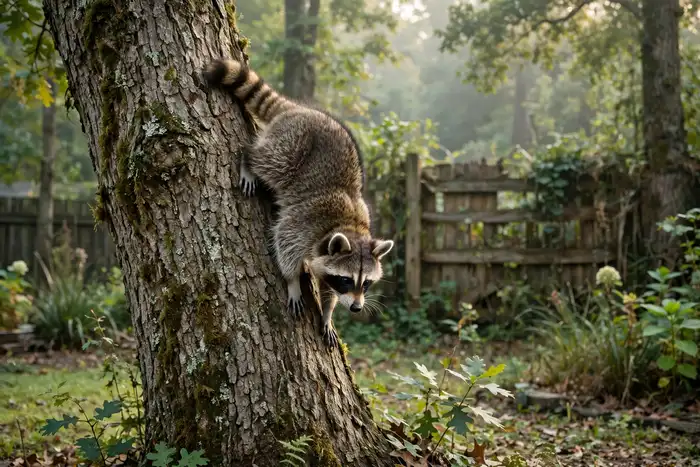
How you know it’s raccoons
If you are on the fence about whether anything is actually inside, start here. The signs below are what we confirm on site in Rockingham County homes every week, and together they tell us how long raccoons have been there.
- Torn soffit or fascia boards
- Droppings near entry points
- Footprints in mud or soft soil
- Noises in attic at night
- Knocked over trash cans
Season matters when you read these signs around Londonderry. The same attic that holds a single wandering raccoon in autumn may hold a mother and a full litter by spring, and the sign left behind looks very different.
Raccoons in the Northeast have become highly urbanized over decades, learning to exploit chimneys, open soffits, and loose roof flashing as denning sites. Attic intrusions in this region often involve nursing females in late winter, requiring exclusion to be timed after young are fully mobile — typically by mid-May.
Field notes — Rockingham County
New Hampshire's short Atlantic coast and Great Bay tidal estuary meet Pawtuckaway's wooded interior in the state's most developed southeastern county.
Portsmouth and Exeter hold colonial-era homes and older multifamily blocks, while Derry, Salem, and Londonderry are dense commuter subdivisions.
Bats recur in older Portsmouth and Exeter homes each summer, raccoons and skunks persist in commuter yards, and moles damage lawns across the suburbs.
Around Londonderry
Neighbourhoods we work: Route 102 corridor (central residential streets) · North Londonderry (older homes and newer subdivisions) · South Londonderry (orchards and rural roads) · Musquash area (homes backing onto conserved woods)
A fast-grown commuter town of 1970s through 2000s subdivisions and newer homes, set among working apple orchards, older farmhouses, and large conserved woodlands.
Musquash Conservation Area (large conserved forest and wetlands), Little Cohas Brook (stream corridor), apple orchards (open farmland across town), Scobie Pond (small pond in the south)
Spring opens with woodchucks under outbuildings and squirrels raising young in attics, while fall brings the shelter-seeking rush before the long winter. Summer is mole season on irrigated lawns. Our crew does a lot of Londonderry exclusion work on subdivision homes where the woods start at the back fence — sealing has to account for pressure that never really lets up.
Londonderry's orchards, fields and big conserved woods keep wildlife woven through its subdivisions. Raccoons and gray squirrels are the everyday attic call, skunks dig under decks and sheds, and moles tear up the well-kept lawns this town is known for. Homes backing onto the Musquash Conservation Area see fishers on trail cameras and steady pressure from the woods, and bats roost in older farmhouses and newer attic spaces alike.
Londonderry sits in Rockingham County. Our crew covers the whole county — including Salem, Portsmouth, Hampton — so if the problem turns out to be at a second property nearby, one call still covers it.
The work
How we get raccoons out of a Londonderry home
Every raccoon job we run in Londonderry follows the same discipline: confirm the species, find every entry, remove humanely, then seal. Skipping the middle step is how animals end up trapped inside walls — the mistake we are most often called to fix after someone else.
- Attic cleanup and decontamination
- Entry point sealing
- Damage repair
- Preventative exclusion
- Live trapping and removal
Around Rockingham County, that usually means seasonal pressure rises and falls with the water and the woods nearby, not with the calendar alone. When habitat along the corridors gets busy, Londonderry homes on the edge of it feel the increase within days, not months.
That final check is what keeps raccoons from simply moving to the next weak spot on the same Londonderry roofline. When you are ready to start, call us, tell us what you have seen, and we will schedule a time that works for you.
Don’t wait on it
Why raccoons get more expensive
Fast removal is essential.
Insurance is a quiet reason not to sit on a raccoon problem in Londonderry. Damage that grows over an ignored season is harder to claim than a problem reported and handled promptly, and our inspection notes document exactly when the activity started.
Waiting rarely makes a raccoon problem smaller in Londonderry. Droppings and urine soak deeper into insulation, odors build through the house, and the scent left behind draws other raccoons to the same entry long after the first one is gone.
Cost
What raccoon removal runs in Londonderry
Every raccoon job in Londonderry breaks down the same way — inspection, removal, exclusion, and any cleanup — but the total moves with the house. Use these typical ranges to budget, and count on us to give you the exact figure before any work begins.
| Job | Typical range |
|---|
| Raccoon Removal — typical Londonderry job | $200–$600+ |
General guidance from typical New Hampshire work — not a quote. Your price is set after we inspect your home, before work starts. See our guides for how pricing breaks down.
RemoveWildlifeNow
Raccoon in Londonderry — handled today
(844) 544-3498
Call us and tell us what you're hearing, seeing or smelling — we'll take it from there. The animals come out, the entry points get sealed, and the mess gets cleaned up.
- Licensed & insured
- Same-day service
- Open 24/7
- Humane methods
Raccoon questions from Londonderry homeowners
What time of year are raccoons worst in New Hampshire?
Raccoons are worst in New Hampshire from December through March, when pregnant females actively seek attic entry points to give birth. A second wave of activity occurs in late summer as juveniles disperse and establish new territories. Londonderry residents should inspect rooflines and soffits in fall — before denning season — to seal entry points before a raccoon moves in.
Can I remove raccoons myself in New Hampshire?
Raccoon removal requires a state permit in New Hampshire, which is issued through the New Hampshire Fish and Game Department. Handling raccoons without proper equipment and licensing carries serious legal and health risks. Licensed contractors in Londonderry hold the required permits and carry the equipment needed to remove raccoons safely, handle them legally under the state's rabies-vector rules, and clean contaminated areas properly.
How much does raccoon removal cost in Londonderry, New Hampshire?
Raccoon removal in New Hampshire typically costs $200–$600+ for trapping and removal. If raccoons have been living in your attic, full remediation including cleanup, decontamination, and entry point sealing generally runs $800–$2,500+ depending on colony size and insulation damage. Call for an estimate specific to your Londonderry property.
Does homeowners insurance cover raccoon damage in New Hampshire?
Some New Hampshire homeowners insurance policies cover sudden, accidental raccoon damage — such as a torn soffit or damaged roof decking. Most policies do not cover gradual damage or the cost of removal itself. Review your policy or call your agent before assuming coverage. Your Londonderry contractor can provide documentation of damage for insurance claims.
Other animals in Londonderry