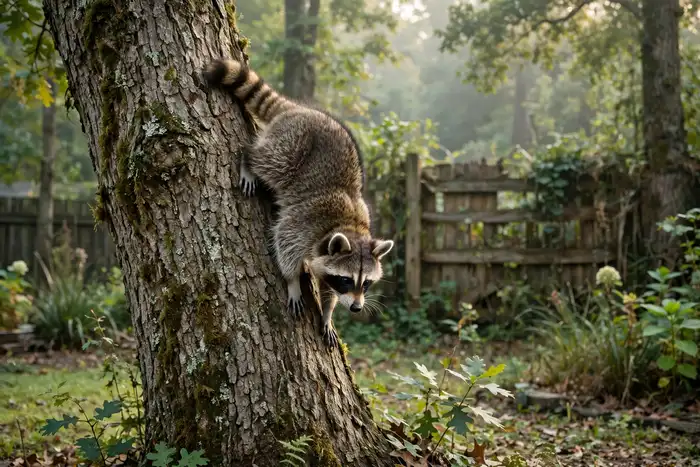
Cherokee County sits at the northern edge of the metro Atlanta exurbs, where the rolling Piedmont uplands transition toward the Blue Ridge foothills. The Etowah River cuts across the county and supports federally listed darter populations; Lake Allatoona forms its southwestern boundary. The combination of two strong wildlife corridors, the older Canton historic core, the rapidly-grown Woodstock subdivisions of the last twenty years, and Reinhardt University's wooded Waleska campus produces consistent year-round raccoon call volume across the county — particularly during fall dispersal and spring whelping.
Signs
How you know it’s raccoons
If you are on the fence about whether anything is actually inside, start here. The signs below are what we confirm on site in Cherokee County homes every week, and together they tell us how long raccoons have been there.
- Torn soffit or fascia boards
- Droppings near entry points
- Footprints in mud or soft soil
- Noises in attic at night
- Knocked over trash cans
If the signs point to the attic, resist the urge to climb up and investigate alone. Raccoons cornered in an attic can bite, and droppings should not be disturbed without protection — note what you can see from the hatch and call us.
Tiny-Village Mountain Park Housing Entry Profile
Mountain Park's housing stock — small-village older housing with mid-century ranches dominant, plus a few rural-edge properties on larger wooded lots — produces predictable raccoon entry-point patterns by construction era:
- Older pre-1940 Mountain Park housing: original masonry chimneys without modern caps, hand-laid brick foundations with pointing failures, original wood soffits with corner separation, pre-modern gable louvers without screen backing.
- Mid-century housing: aluminum gable-vent screens that have aged through, original wood soffit returns with corner separation, brick-veneer separation at chimney chases, slab-on-grade foundation-vent failures.
- Newer 1990s+ construction: vinyl-soffit chew-throughs at corners, builder-grade chimney chase caps, attic-fan housings, soffit-fascia gaps at roof-slope transitions.
Most Mountain Park jobs identify 2-4 viable entry points per property; older properties at the upper end. Georgia DNR Wildlife Resources Division Region 1 (Armuchee) licensing applies to all commercial trapping; our operators hold the required state credentials.
Cherokee's Etowah-Allatoona Watershed Drives Raccoon Density
Two major waterways anchor Cherokee's wildlife profile. The Etowah River runs east to west across the southern half of the county and supports a federally listed fish population (the Cherokee darter, federally threatened, and the Etowah darter, federally endangered) — a fact that places the river corridor under heightened federal habitat protection but also reflects the watershed's overall ecological richness. Lake Allatoona forms the county's southwestern boundary and shares a continuous wooded shoreline with Bartow and Cobb counties. Both watersheds sustain dense year-round raccoon source populations that disperse northward into Cherokee subdivisions every fall.
The Allatoona Creek tributary system drains the western portion of the county, and the smaller creeks feeding the Etowah (Long Swamp Creek, Hightower Creek, Woodstock Creek) all serve as raccoon travel corridors. Female raccoons whelping in spring routinely select Cherokee residential attics over natural den sites because the subdivisions provide better climate stability than tree-cavity dens along these actively-used corridors. Sharp Mountain in the eastern part of the county and Blackjack Mountain in the south add elevation-edge habitat that contributes additional source population.
Why Cherokee's Mix of Historic and New Subdivisions Affects Raccoon Calls
Cherokee's housing stock spans a wider construction range than most metro-Atlanta counties — from pre-1900 brick storefronts and worker housing in the Canton historic district through 1960s-1970s small-town infill all the way to massive 1990s-2010s subdivision development across Woodstock, Holly Springs, and the Hwy 92 corridor. Each era has a distinct raccoon entry profile:
- Pre-1940 historic Canton: original masonry chimneys without modern caps, hand-laid brick foundations with pointing failures, original wood soffits with corner separation, original gable louvers without screen backing.
- Mid-century Canton, Holly Springs, Ball Ground, Waleska: aluminum gable-vent screens that have aged through, original wood soffit returns, brick-veneer separation at chimney chases.
- 1990s-2010s Woodstock and Hwy 92 corridor subdivisions: vinyl-soffit chew-throughs at corners, soffit-fascia gaps at roof-slope transitions, attic-fan housings, builder-grade chimney chase caps.
The mixed housing stock means Cherokee jobs frequently require property-specific exclusion plans rather than a standard template. Older Canton historic-district homes routinely identify 4-5 viable entry points; newer Woodstock subdivision jobs typically have 2-3. Georgia DNR Wildlife Resources Division Region 1 (Armuchee) licensing applies to all commercial trapping; our operators hold the required state credentials.
Southeastern raccoons are active year-round due to the mild climate, with the highest call volumes in late winter denning season and again in summer when juveniles disperse. Raccoon roundworm (Baylisascaris procyonis) is a documented public health concern in the region, making professional attic remediation after removal essential.
Field notes — Cherokee County
Piedmont uplands rising toward the Blue Ridge foothills, crossed by the Etowah River. Lake Allatoona borders the southwest, and Sharp and Blackjack mountains add unbroken forest to the north.
Stock ranges from pre-1900 mill housing in Canton to small-town homes in Ball Ground. The bulk is 1990s-2010s subdivision growth in Woodstock and Holly Springs, much of it backing onto woods and creeks.
The Etowah corridor holds a continuous raccoon population, and Allatoona shoreline forest supports bats along the southern boundary. Roof rats followed I-575 into Woodstock subdivisions, while forest-edge homes see steady squirrels, opossums, and armadillos.
Mountain Park sits in Cherokee County, whose county seat is Canton. Our crew covers the whole county — including Woodstock, Holly Springs, Ball Ground — so if the problem turns out to be at a second property nearby, one call still covers it.
The work
How we get raccoons out of a Mountain Park home
Cleanup is scheduled as part of the same job, not sold as an afterthought. Once raccoons are out and the entries are sealed, fouled material comes out and the space is treated, so your Mountain Park attic does not keep advertising itself to the next animal.
- Attic cleanup and decontamination
- Entry point sealing
- Damage repair
- Preventative exclusion
- Live trapping and removal
Around Cherokee County, that usually means the same property features that make a street feel wooded and private also shelter wildlife. In Mountain Park, trimming access, sealing gaps, and removing ground-level harborage near the house often matter as much as the removal itself.
That final check is what keeps raccoons from simply moving to the next weak spot on the same Mountain Park roofline. When you are ready to start, call us, tell us what you have seen, and we will schedule a time that works for you.
Don’t wait on it
Why raccoons get more expensive
Raccoons breed in attics and their feces carry dangerous roundworm spores.
There is also a safety side to raccoon problems in Mountain Park that goes beyond property damage. Droppings and nesting can carry disease, some species bite or spray when cornered, and chewed wiring in an attic is a fire risk — all reasons this belongs with a licensed crew, not a ladder and a guess.
Waiting rarely makes a raccoon problem smaller in Mountain Park. Droppings and urine soak deeper into insulation, odors build through the house, and the scent left behind draws other raccoons to the same entry long after the first one is gone.
Cost
What raccoon removal runs in Mountain Park
Every raccoon job in Mountain Park breaks down the same way — inspection, removal, exclusion, and any cleanup — but the total moves with the house. Use these typical ranges to budget, and count on us to give you the exact figure before any work begins.
| Job | Typical range |
|---|
| Raccoon Removal — typical Mountain Park job | $200–$600+ |
General guidance from typical Georgia work — not a quote. Your price is set after we inspect your home, before work starts. Full breakdown: what wildlife removal costs in Georgia.
Your local wildlife crew
Raccoon in Mountain Park — handled today
Pro X Services
(404) 531-7780
Call us and tell us what you're hearing, seeing or smelling — we'll take it from there. The animals come out, the entry points get sealed, and the mess gets cleaned up.
- Licensed & insured
- Same-day service
- Open 24/7
- Humane methods
Raccoon questions from Mountain Park homeowners
How much does raccoon removal cost in Mountain Park, Georgia?
Most Mountain Park raccoon jobs run between $400 and $1300+ depending on entry-point count, kit presence, and remediation scope. Single-entry trap-and-release jobs in newer construction sit at the floor; multi-entry historic-housing properties run higher. Mountain Park's small ~500 population means absolute job count is low but per-property pressure can be significant given the surrounding wildlife corridors. Properties with contaminated insulation that need full sanitation can run higher; single-entry trap-and-release jobs sit at the floor. Call for a free property-specific estimate.
How do I know if I have raccoons in my Mountain Park attic?
Sound is the clearest tell — heavy thumping or chittering from the ceiling around dusk and just before dawn, with the activity feeling like "someone walking up there" because raccoons are far heavier than squirrels. Other signs include damaged fascia or soffits, claw marks on downspouts and gutters, droppings on the roof or in the yard near downspouts, and the smell of urine penetrating ceiling drywall. Entry holes are typically 4-6 inches across — much larger than squirrel or rat openings.
When can I evict raccoons from my Mountain Park attic?
Female raccoons in this part of Georgia whelp <strong>late February through early May</strong>, and kits are immobile and dependent until roughly 8-10 weeks of age. Performing exclusion during that window risks separating mother from kits and trapping kits inside the structure. Right approach during kit season is one-way doors that let the family exit but not re-enter, deployed once kits are mobile. Inspections and entry-point identification can happen any time of year.
Can I trap and remove raccoons myself in Georgia?
Property owners can take limited action against nuisance raccoons under Georgia regulations, but the rules are restrictive and the practical risks are high. Relocating a live-trapped raccoon off your property is regulated; lethal control must comply with state hunting regulations; any handling carries real rabies-exposure risk. Commercial trapping in Georgia requires a Georgia DNR Wildlife Resources Division Trapping License, and Mountain Park falls under DNR Region 1 (Armuchee). Hiring a licensed local operator is faster, safer, and legally cleaner.
Are raccoons more common in rural Cherokee County areas like Mountain Park?
Yes — rural and small-town Cherokee County properties take consistent dispersal pressure from the surrounding undeveloped wildlife habitat. While the absolute residential call volume in Mountain Park is lower than in larger Cherokee cities, per-property pressure can be higher because of the proximity to source-population habitat and the limited buffer between developed and undeveloped land. Properties along Cherokee-Fulton boundary woodlands or backing up to wooded acreage take heaviest pressure during September-November dispersal.
What time of year are raccoons worst in Georgia?
Raccoons are worst in Georgia from December through March, when pregnant females actively seek attic entry points to give birth. A second wave of activity occurs in late summer as juveniles disperse and establish new territories. Mountain Park residents should inspect rooflines and soffits in fall — before denning season — to seal entry points before a raccoon moves in.
Other animals in Mountain Park