Calls about armadillos in Macon tend to cluster on the same few streets — the ones where the canopy closes over the roofs and the lots back onto creeks or woods. If your home sits in country like that, an inspection is worth it even before the noises start.
Most Macon homeowners notice one sign and miss the rest, because armadillos are quiet tenants during the day. Check the full list below, especially around vents, soffits, and the chimney, and note anything that looks fresh or recently disturbed.
Burrow entrances under porches, decks, or driveways
Uprooted sod and damaged flower beds
Cracked or settling concrete near burrows
Armadillo sightings at dusk or after dark
Shallow holes and rooted-up patches across the lawn
If the signs point to the attic, resist the urge to climb up and investigate alone. Armadillos cornered in an attic can bite, and droppings should not be disturbed without protection — note what you can see from the hatch and call us.
Field notes — Bibb County
Macon sits on the Fall Line where Piedmont meets Coastal Plain, with the Ocmulgee River bisecting the county and Lake Tobesofkee to the west. Tobesofkee and Walnut creeks drain wooded bottomland through much of the area.
Pre-1860 antebellum homes dominate Vineville, In-Town, and Beall's Hill, alongside pre-1900 Pleasant Hill blocks and mid-century Ingleside homes. Newer subdivisions ring the northern and western edges.
Antebellum chimneys host bat colonies occupied for decades, and the Ocmulgee corridor feeds raccoons and opossums intown. Fox squirrels, Brazilian free-tailed bats, and long-established armadillos reflect the warmer southern mix.
Around Macon
Neighbourhoods we work: Pleasant Hill Historic District · Tattnall Square / Mercer University area · Wesleyan College area (Forsyth Road) · Shirley Hills (post-WWII residential) · Ingleside (post-WWII residential)
Macon (~155,000 within the consolidated Macon-Bibb government) combines an exceptional pre-1860 antebellum housing inventory across the Vineville, In-Town, Beall's Hill, and Pleasant Hill historic districts with three university campus zones (Mercer, Wesleyan, Middle Georgia State), mid-century post-WWII residential stock in Shirley Hills and Ingleside, the Mulberry Street and Cherry Street pre-1860 historic-downtown commercial corridors, and 1980s-2010s subdivision growth on the western and northern edges of the consolidated city.
Macon is the largest consolidated city-county government in Georgia and the regional anchor for central Georgia, with a wildlife-pressure profile shaped by the Fall Line geological transition that sets it apart from any north Georgia city. Pre-1860 Vineville, In-Town, and Beall's Hill historic districts contain antebellum and Victorian housing that produces a multi-entry-point profile of original common-bond brick foundations, deep-set masonry chimneys, recessed gable louvers without screen backing, and original heart-pine soffit construction. Older Macon homes with original masonry chimneys commonly host long-established bat colonies. The Mercer University, Wesleyan College, and Middle Georgia State student-housing districts add a year-round dumpster-driven raccoon, squirrel, and Norway rat call profile. Fox squirrels (a Coastal Plain species) appear alongside Eastern grays in Macon residential calls — rare further north — and armadillos are now routine residential lawn-rooting calls. Norway and roof rats are common in older downtown Macon and established countywide. The Ocmulgee corridor and Ocmulgee Mounds National Historical Park sustain a continuous source population that disperses into the older intown housing, with raccoon pressure heaviest during whelping from late February through May. Macon's 350,000+ Yoshino cherry trees and the late-March bloom coincide with a seasonal uptick in squirrel activity.
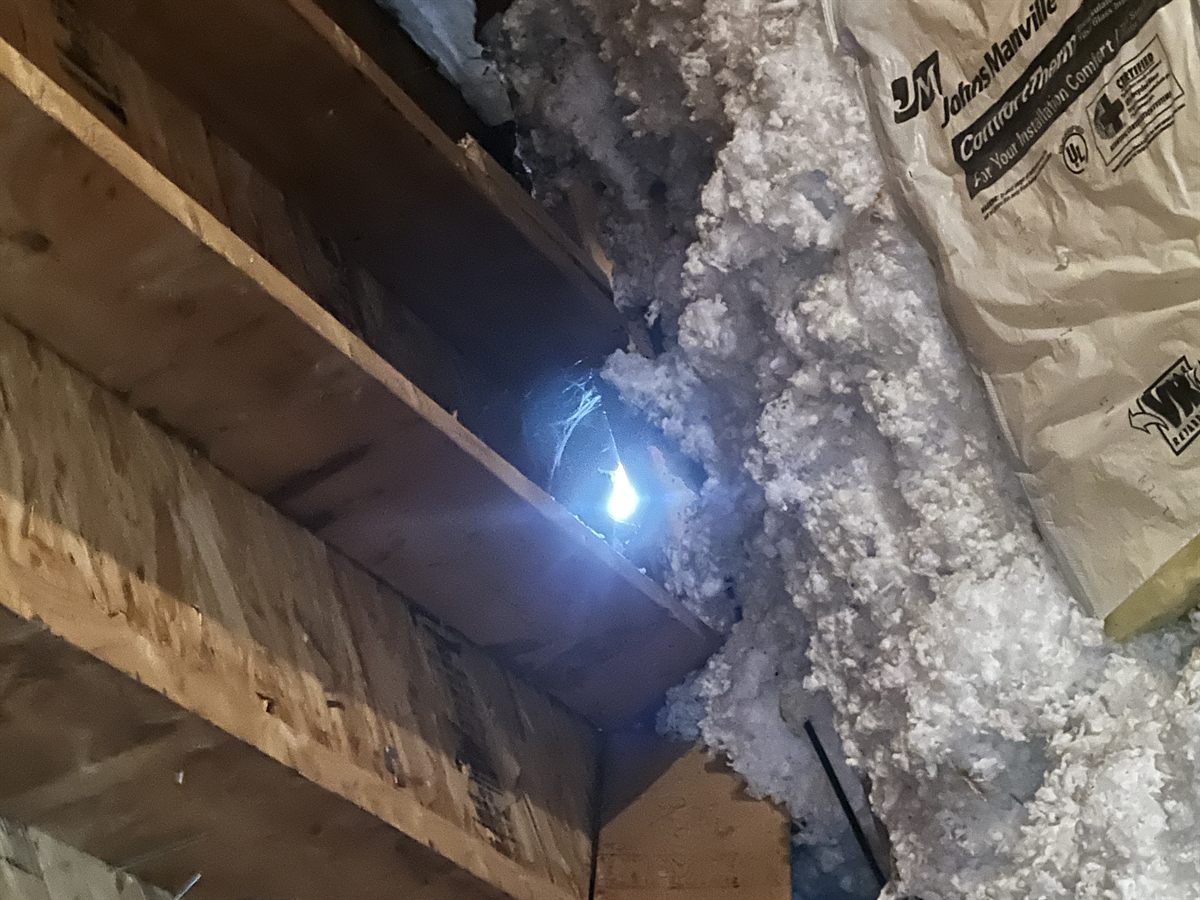
A typical roofline entry point found during a Macon attic inspection — daylight through a soffit/roof gap, with insulation disturbed by squirrel, rat, and raccoon traffic. Sealing gaps like this is the core of permanent exclusion.
Macon Animal Control vs. Private Wildlife Removal — What's Free and What Isn't
Macon homeowners frequently call Macon-Bibb County Animal Welfare first when they have a wildlife problem, only to find that municipal animal control here handles domestic-animal complaints — stray dogs, cats, leash-law issues — and generally does not respond to nuisance wildlife in attics, chimneys, walls, or yards. Knowing the right contact for each situation saves a call and gets the right people to the property faster:
Injured or orphaned wildlife (fawn, fallen baby bird, sick raccoon) — a permitted Georgia DNR wildlife rehabilitator. Free or donation-based.
Rabies-vector exposure (a bat found in a bedroom, a bite or scratch from any mammal) — North Central Health District (the regional public-health authority) and your physician or veterinarian. Insurance-billed.
Nuisance wildlife removal and exclusion (raccoons in the chimney, bats in the attic, squirrels chewing wires, snakes in the yard) — a licensed private contractor. Paid service.
Alligator over 4 feet on the lower Ocmulgee — Georgia DNR Wildlife Resources Division (Fort Valley office). Free.
Macon sits in Bibb County. Our crew covers the whole county — including Payne — so if the problem turns out to be at a second property nearby, one call still covers it.
The work
How we get armadillos out of a Macon home
Cleanup is scheduled as part of the same job, not sold as an afterthought. Once armadillos are out and the entries are sealed, fouled material comes out and the space is treated, so your Macon attic does not keep advertising itself to the next animal.
Yard damage assessment
Exclusion barriers for repeat areas
Grub-pressure reduction advice
Live trapping and removal
Burrow location and closure
Around Bibb County, that usually means the same property features that make a street feel wooded and private also shelter wildlife. In Macon, trimming access, sealing gaps, and removing ground-level harborage near the house often matter as much as the removal itself.
Once the steps above are done, we walk the property with you and show you exactly what was closed and why. If anything new turns up in the days after, call us and tell us what you are hearing — we would rather hear early.
Don’t wait on it
Why armadillos get more expensive
An armadillo can root up a lawn in a single night, and burrows under concrete cause settling and cracks.
There is also a safety side to armadillo problems in Macon that goes beyond property damage. Droppings and nesting can carry disease, some species bite or spray when cornered, and chewed wiring in an attic is a fire risk — all reasons this belongs with a licensed crew, not a ladder and a guess.
An entry point used by armadillos does not stay the same size. Claws, weather, and repeated use widen it, rain follows the same path into the attic, and other wildlife in Bibb County — insects included — find the opening too. Early action keeps the fix small.
Cost
What armadillo removal runs in Macon
Think of the costs below as a realistic local range for Macon, not a promise. When you call us, tell us the signs and the size of the home, and we will explain which end of the range your situation most likely falls on, and why.
Job
Typical range
Armadillo Removal — typical Macon job
$250–$600+
General guidance from typical Georgia work — not a quote. Your price is set after we inspect your home, before work starts. Full breakdown: what wildlife removal costs in Georgia.
Call us and tell us what you're hearing, seeing or smelling — we'll take it from there. The animals come out, the entry points get sealed, and the mess gets cleaned up.
Licensed & insured
Same-day service
Open 24/7
Humane methods
Armadillo questions from Macon homeowners
How much does wildlife removal cost in Bibb County?