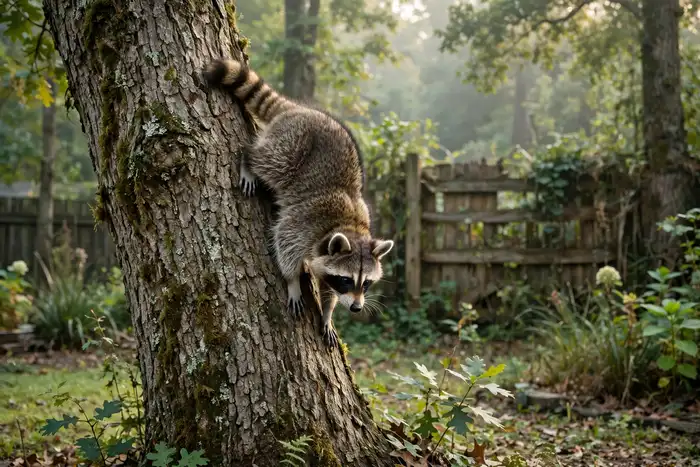
Monroe County's residential raccoon profile is shaped by three distinct pressure systems: Forsyth's substantial pre-1900 antebellum and Victorian historic-downtown housing inventory around the Monroe County Courthouse square, the I-75 corridor commercial cluster at the Forsyth exits (185-188) — one of the larger I-75 commercial concentrations between Atlanta and Macon-Bibb, and Lake Juliette plus the surrounding Plant Scherer shoreline forest in eastern Monroe.
Signs
How you know it’s raccoons
Our crew checks for the same pattern of evidence on nearly every Juliette call, and you can spot much of it yourself. Look for the following around your roofline, attic, and crawl space before you call us.
- Torn soffit or fascia boards
- Droppings near entry points
- Footprints in mud or soft soil
- Noises in attic at night
- Knocked over trash cans
Check the quiet corners first: behind the chimney, above the bathroom fan, along the eaves where the insulation meets the roof deck. In Monroe County homes, raccoons settle where it is darkest and least disturbed.
Forsyth Pre-1900 Antebellum Housing + I-75 Forsyth Exits
Forsyth's pre-1900 housing around the Monroe County Courthouse square — Forsyth was incorporated 1823 — shows original masonry chimneys without modern caps, hand-laid brick foundations, pre-modern wood soffits, and antebellum brick-veneer separation. Most Forsyth historic-district raccoon jobs identify 4-5 viable entry points per property. The pre-1900 Forsyth inventory is unusually intact for a central-Georgia county-seat town and is comparable in density to Barnesville's Buggy Capital antebellum core.
The I-75 corridor commercial cluster at the Forsyth exits (185-188) is one of the larger I-75 commercial concentrations between Atlanta and Macon-Bibb — substantial restaurant, gas station, hotel, and retail footprint that produces a heavy raccoon food-subsidy vector. Residential blocks adjacent to the I-75 cluster absorb continuous dispersal pressure year-round.
Lake Juliette + Plant Scherer Shoreline-Forest Source Pressure
Lake Juliette — the Plant Scherer cooling-water reservoir on the eastern side of Monroe — sustains a substantial raccoon source population in the surrounding shoreline forest. The combined lake-and-shoreline-forest habitat block disperses raccoons across northeastern Monroe properties. Properties along the Lake Juliette shoreline, in the Juliette community, and in the broader eastern Monroe rural-residential zone absorb the heaviest shoreline-forest dispersal pressure.
The Towaliga River corridor on the northern boundary and the Ocmulgee River corridor on the eastern boundary contribute additional source pressure. Georgia DNR Region 1 (Northeast) licensing applies for all commercial trapping in Monroe County.
Southeastern raccoons are active year-round due to the mild climate, with the highest call volumes in late winter denning season and again in summer when juveniles disperse. Raccoon roundworm (Baylisascaris procyonis) is a documented public health concern in the region, making professional attic remediation after removal essential.
Field notes — Monroe County
Central Piedmont between Atlanta and Macon, with the Towaliga River and High Falls north and the Ocmulgee River east. Lake Juliette and Plant Scherer dominate the east with shoreline forest.
Forsyth holds a substantial pre-1900 core around its courthouse square, plus homes near the former Tift College campus. Bolingbroke is an upscale corridor toward Macon, and rural homes fill the rest.
Forsyth's old chimneys hold bat colonies spanning many decades, while the I-75 exit cluster sustains Norway rats dispersing into nearby blocks. Lake Juliette's shoreline supports raccoons and bats, including free-tailed colonies using plant structures nearby.
Around Juliette
Neighbourhoods we work: Juliette community center (Whistle Stop Cafe historic core) · Pre-1900 mill-village small-community housing · Lake Juliette shoreline residential · 1900s-1980s rural-residential housing · Newer 1990s-2010s lakefront and rural-acreage construction
Juliette (~600) is an unincorporated community in northeastern Monroe County famous as the filming location for the 1991 film Fried Green Tomatoes (the Whistle Stop Cafe is still in operation). Juliette sits on the Ocmulgee River corridor adjacent to Lake Juliette and Georgia Power's Plant Scherer — one of the largest coal-fired power plants in the United States.
Pre-1900 Juliette Historic Community Core (Whistle Stop Cafe / Fried Green Tomatoes 1991 film location),Lake Juliette (Plant Scherer cooling-water reservoir),Georgia Power Plant Scherer (one of the largest coal-fired power plants in the United States),Ocmulgee River corridor (eastern Juliette boundary),Piedmont National Wildlife Refuge adjacency (just north / east of Juliette),Lake Juliette shoreline forest,Rural-acreage agricultural and forest land surrounding Juliette
Juliette's wildlife profile is distinctive in Monroe County because of Lake Juliette and Plant Scherer. The cooling-water reservoir and surrounding shoreline forest support a substantial waterfowl, raccoon, bat, and snake source population that disperses across the Juliette community. Plant Scherer infrastructure hosts Brazilian free-tailed bat (Tadarida brasiliensis) maternity colonies — expansion-joint gaps, equipment-housing cavities, and adjacent industrial buildings provide ideal roost habitat. Pre-1900 small-community housing along the Juliette historic core hosts secondary big-brown bat chimney colonies with 30-60 year tenure. Bald eagles (Haliaeetus leucocephalus) nest on Lake Juliette and require Bald and Golden Eagle Protection Act setbacks. Piedmont National Wildlife Refuge adjacency contributes additional source pressure across all common Piedmont species. The Ocmulgee River corridor produces occasional cottonmouth encounters at the species's northern Piedmont limit.
Juliette sits in Monroe County, whose county seat is Forsyth. Our crew covers the whole county — including Bolingbroke, Forsyth, Culloden — so if the problem turns out to be at a second property nearby, one call still covers it.
The work
How we get raccoons out of a Juliette home
Expect us to show you what we find as we go — entry points, damage, the evidence for how long raccoons have been inside your Juliette home. You should never have to take the scope of the work on faith.
- Preventative exclusion
- Live trapping and removal
- Attic cleanup and decontamination
- Entry point sealing
- Damage repair
Around Monroe County, that usually means entry points cluster where the house meets the landscape: low rooflines under canopy, decks over crawl spaces, and chimneys on older homes. Our crew in Juliette starts at those junctions because that is where raccoons test first.
No two Juliette homes take exactly the same fix, which is why we finish with recommendations specific to your roof, your lot, and your trees. Call us and describe the signs, and we will tell you honestly what we would do first.
Don’t wait on it
Why raccoons get more expensive
Fast removal is essential.
Finally, the entry itself is a weather problem. Every opening raccoons use in a Juliette roofline is also a path for rain, and attic moisture plus contaminated insulation is how a wildlife call turns into a carpentry bill.
The biggest risk of waiting through a breeding season in Juliette is simple arithmetic. One female raccoon becomes a litter raised in your attic, and a litter becomes several animals using several entry points by the time they leave — if they leave.
Cost
What raccoon removal runs in Juliette
Homeowners in Juliette understandably want a number before they call, so use the ranges below as planning guidance only — not a quote. Your actual cost depends on entry points, cleanup, and how long raccoons have been inside, which we confirm on site.
| Job | Typical range |
|---|
| Raccoon Removal — typical Juliette job | $200–$600+ |
General guidance from typical Georgia work — not a quote. Your price is set after we inspect your home, before work starts. Full breakdown: what wildlife removal costs in Georgia.
Your local wildlife crew
Raccoon in Juliette — handled today
Central Georgia Wildlife Control LLC
(404) 738-9764
Call us and tell us what you're hearing, seeing or smelling — we'll take it from there. The animals come out, the entry points get sealed, and the mess gets cleaned up.
- Licensed & insured
- Same-day service
- Open 24/7
- Humane methods
Raccoon questions from Juliette homeowners
How much does raccoon removal cost in Juliette, Georgia?
Raccoon removal in Georgia typically costs $200–$600+ for trapping and removal. If raccoons have been living in your attic, full remediation including cleanup, decontamination, and entry point sealing generally runs $800–$2,500+ depending on colony size and insulation damage. Call for an estimate specific to your Juliette property.
Does homeowners insurance cover raccoon damage in Georgia?
Some Georgia homeowners insurance policies cover sudden, accidental raccoon damage — such as a torn soffit or damaged roof decking. Most policies do not cover gradual damage or the cost of removal itself. Review your policy or call your agent before assuming coverage. Your Juliette contractor can provide documentation of damage for insurance claims.
Are raccoons dangerous to my family in Juliette?
Yes. Raccoons in Georgia are one of the primary wildlife carriers of rabies and shed Baylisascaris roundworm in their feces — a parasite that can be fatal to humans and pets. Attic-dwelling raccoons contaminate insulation with droppings that remain infectious long after the animals are gone. Professional cleanup after removal is not optional — it is a health necessity.
What time of year are raccoons worst in Georgia?
Raccoons are worst in Georgia from December through March, when pregnant females actively seek attic entry points to give birth. A second wave of activity occurs in late summer as juveniles disperse and establish new territories. Juliette residents should inspect rooflines and soffits in fall — before denning season — to seal entry points before a raccoon moves in.
Other animals in Juliette