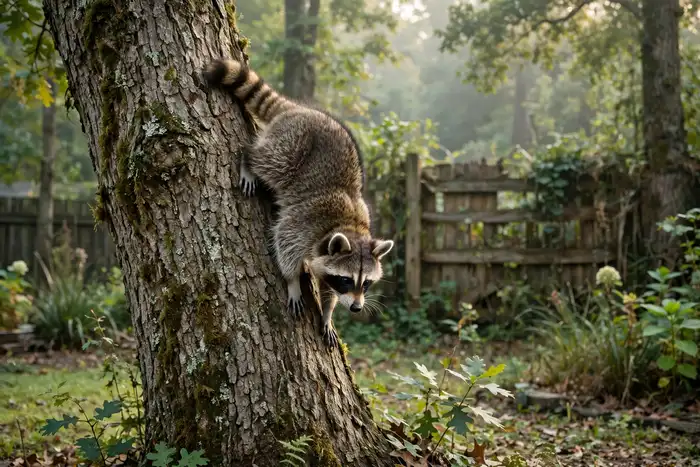
Raccoons are among the highest-volume residential wildlife calls in DeKalb County, driven by a rare combination of dense pre-WWII intown housing, the Olmsted-designed canopy through Druid Hills and Decatur, the South Fork Peachtree Creek and South River corridors, and the granite-outcrop habitat edge at Stone Mountain and Arabia Mountain. Northern raccoons (Procyon lotor) are the only raccoon species in Georgia, and DeKalb's mix of 1920s-1940s craftsman bungalows, mature oak-hickory tree cover, restaurant-district food density in Decatur and Brookhaven Village, and proximity to multiple state parks makes the county one of the highest raccoon-pressure jurisdictions in the metro Atlanta area.
Signs
How you know it’s raccoons
Most Avondale Estates homeowners notice one sign and miss the rest, because raccoons are quiet tenants during the day. Check the full list below, especially around vents, soffits, and the chimney, and note anything that looks fresh or recently disturbed.
- Knocked over trash cans
- Torn soffit or fascia boards
- Droppings near entry points
- Footprints in mud or soft soil
- Noises in attic at night
Take photos of anything you find and show us when we arrive in Avondale Estates. Clear pictures of droppings, entry gaps and damage help us confirm the species and the scale of the job before we open anything up.
Health and Safety Risks From DeKalb Raccoons
Georgia is a rabies-endemic state, and raccoons are the single most common rabies vector species in the state. Any DeKalb resident bitten or scratched by a raccoon should contact the DeKalb County Board of Health immediately and not attempt to handle or release the animal. Beyond rabies, raccoon roundworm (Baylisascaris procyonis) is present in DeKalb raccoon feces and is dangerous to humans and pets — particularly children who might come into contact with attic insulation contaminated by an infestation. Leptospirosis is transmitted through raccoon urine, including dried urine in attic dust. Canine distemper is fatal to unvaccinated dogs and can spread from raccoon contact. On the property side, raccoons in attics typically destroy 20-40% of the affected insulation, gnaw HVAC ductwork, and chew electrical wiring — a fire risk that homeowners' insurance underwriters take seriously, and one that's especially severe in older Decatur and Druid Hills homes where original cloth-jacketed wiring may still be in place.
Georgia Wildlife Regulations That Apply to Raccoon Removal
Raccoons in Georgia are classified as both a game animal and a nuisance species, which puts them under a layered regulatory regime. Commercial removal requires a Georgia DNR Wildlife Resources Division Trapping License, and any lethal control on a contract job requires a Nuisance Wildlife Control Permit. DeKalb falls under Georgia DNR Region 1, headquartered at the Armuchee office. Property owners may handle nuisance raccoons on their own property under specific conditions outlined in state regulations, but relocating live-trapped raccoons off-property is restricted, and lethal control must comply with state hunting regulations. Our operators hold the applicable state credentials.
Our DeKalb County Raccoon Removal Process
A typical DeKalb raccoon removal job runs roughly as follows: an initial inspection of the attic, chimney, crawlspace, and the full exterior of the home; identification of every entry point (the average is 2-5 per infestation, more in Decatur and Druid Hills historic homes); live trapping per Georgia DNR regulations or one-way exclusion doors when kits are present and active; professional sealing of all entry points using galvanized steel mesh and code-appropriate flashing; sanitation and decontamination of contaminated insulation, dropping zones, and travel paths; and damage repair, including insulation replacement and HVAC duct repair where needed. The full process from first call to final exclusion typically runs 5-14 days, depending on whether kits are present and whether structural repair is required. See our full Georgia wildlife removal coverage for the broader service area context.
Southeastern raccoons are active year-round due to the mild climate, with the highest call volumes in late winter denning season and again in summer when juveniles disperse. Raccoon roundworm (Baylisascaris procyonis) is a documented public health concern in the region, making professional attic remediation after removal essential.
Field notes — DeKalb County
Eastern metro Atlanta, bisected by Peachtree Creek's forks and the South River. Stone Mountain and Arabia Mountain granite outcrops anchor large preserved woodlands, with the Yellow River on the eastern boundary.
The county holds metro Atlanta's densest pre-WWII intown stock — Decatur, Druid Hills, and East Atlanta homes from the 1900s-1940s under old canopy. Established 1960s-1980s suburbs ring Stone Mountain.
Old intown attics sustain bat colonies, flying squirrels, and heavy roof rat pressure fed by restaurant districts. Druid Hills canopy produces some of the metro's highest squirrel densities, and Stone Mountain disperses raccoons into surrounding streets.
Avondale Estates sits in DeKalb County, whose county seat is Decatur. Our crew covers the whole county — including Tucker, Stone Mountain, Chamblee — so if the problem turns out to be at a second property nearby, one call still covers it.
The work
How we get raccoons out of a Avondale Estates home
We work from the outside in on Avondale Estates homes: entries mapped first, then removal timed to the animal's own movements. That sequencing is what lets most raccoons leave on their own through one-way exits instead of being chased around your attic.
- Entry point sealing
- Damage repair
- Preventative exclusion
- Live trapping and removal
- Attic cleanup and decontamination
Around DeKalb County, that usually means a yard sighting and an attic problem are connected, even when they seem weeks apart. raccoons pattern a property over time in Avondale Estates, and showing us where you have seen them helps us find where they are getting in.
Once the steps above are done, we walk the property with you and show you exactly what was closed and why. If anything new turns up in the days after, call us and tell us what you are hearing — we would rather hear early.
Don’t wait on it
Why raccoons get more expensive
Fast removal is essential.
The attic environment itself works against waiting in Georgia: summer heat drives odor through the whole house, and winter pushes raccoons deeper into wall voids and insulation, where every part of the job gets harder.
An entry point used by raccoons does not stay the same size. Claws, weather, and repeated use widen it, rain follows the same path into the attic, and other wildlife in DeKalb County — insects included — find the opening too. Early action keeps the fix small.
Cost
What raccoon removal runs in Avondale Estates
Think of the costs below as a realistic local range for Avondale Estates, not a promise. When you call us, tell us the signs and the size of the home, and we will explain which end of the range your situation most likely falls on, and why.
| Job | Typical range |
|---|
| Raccoon Removal — typical Avondale Estates job | $200–$600+ |
General guidance from typical Georgia work — not a quote. Your price is set after we inspect your home, before work starts. Full breakdown: what wildlife removal costs in Georgia.
RemoveWildlifeNow
Raccoon in Avondale Estates — handled today
(844) 544-3498
Call us and tell us what you're hearing, seeing or smelling — we'll take it from there. The animals come out, the entry points get sealed, and the mess gets cleaned up.
- Licensed & insured
- Same-day service
- Open 24/7
- Humane methods
Raccoon questions from Avondale Estates homeowners
Are raccoons dangerous to my family in Avondale Estates?
Yes. Raccoons in Georgia are one of the primary wildlife carriers of rabies and shed Baylisascaris roundworm in their feces — a parasite that can be fatal to humans and pets. Attic-dwelling raccoons contaminate insulation with droppings that remain infectious long after the animals are gone. Professional cleanup after removal is not optional — it is a health necessity.
What time of year are raccoons worst in Georgia?
Raccoons are worst in Georgia from December through March, when pregnant females actively seek attic entry points to give birth. A second wave of activity occurs in late summer as juveniles disperse and establish new territories. Avondale Estates residents should inspect rooflines and soffits in fall — before denning season — to seal entry points before a raccoon moves in.
Can I remove raccoons myself in Georgia?
Raccoon removal requires a state permit in Georgia, which is issued through the Georgia Department of Natural Resources. Handling raccoons without proper equipment and licensing carries serious legal and health risks. Licensed contractors in Avondale Estates hold the required permits and carry the equipment needed to remove raccoons safely, handle them legally under the state's rabies-vector rules, and clean contaminated areas properly.
How much does raccoon removal cost in Avondale Estates, Georgia?
Raccoon removal in Georgia typically costs $200–$600+ for trapping and removal. If raccoons have been living in your attic, full remediation including cleanup, decontamination, and entry point sealing generally runs $800–$2,500+ depending on colony size and insulation damage. Call for an estimate specific to your Avondale Estates property.
Are there protected species in DeKalb County I should be aware of?
Yes. The federally proposed tricolored bat (<em>Perimyotis subflavus</em>) is documented in the Stone Mountain Park and Davidson-Arabia Mountain habitats; any encounter requires careful protocol. The little brown bat (<em>Myotis lucifugus</em>) has been drastically reduced by white-nose syndrome and is treated as significant on any encounter. Bald eagles are protected under the Bald and Golden Eagle Protection Act and the Migratory Bird Treaty Act. All bats are protected by Georgia DNR regulations during maternity season (May-August). Migratory birds (Canada geese, owls, hawks, woodpeckers) require federal Migratory Bird Treaty Act permits for any active take. Licensed contractors are required to know which species can be handled directly and which require specific federal or state permitting.
What wildlife is most common in DeKalb County, Georgia?
In residential calls across DeKalb County, eastern gray squirrels, raccoons, big brown bats, roof rats, and Virginia opossums make up the bulk of attic and yard intrusions. Southern flying squirrel colonies are a notable secondary species in the older intown housing through Druid Hills, Decatur, Avondale Estates, Candler Park, and Kirkwood. Snake calls — primarily eastern rat snakes and the occasional copperhead — concentrate around Stone Mountain Park, Arabia Mountain, and the Lullwater Preserve area at Emory. Coyotes are firmly established in Druid Hills, Decatur, and the South Fork Peachtree Creek corridor. Larger species — white-tailed deer at Stone Mountain Park, the occasional black bear that wanders through, and alligators along the lower South River — fall under direct Georgia DNR Wildlife Resources Division management rather than the private removal industry.
Other animals in Avondale Estates