Raccoons in Warner Robins, GA — A Wildlife Pro's Late-Spring Attic Guide
Late May in Warner Robins is the highest-call-volume window of the year for raccoons in attics. Robins AFB buffer feeds the source population, post-WWII housing in Wellston and Pleasant Hill gives them the entry points, and kit season pushes the noise above the ceiling. Here is what is going on and what proper exclusion looks like.
By Justin McCalvin
Late May in Warner Robins is the highest-call-volume window of the year for raccoons in attics. Female raccoons denned in February, kits are now five to ten weeks old, and the noise is starting to push Wellston, Pleasant Hill, Lake Joy, and northern Warner Robins homeowners to pick up the phone. The Robins AFB buffer on the south side of the city is one of the largest contiguous wildlife source habitats in middle Georgia, and the post-WWII housing inventory north of the base gives raccoons exactly the entry points they need. Here is what is going on, why your specific house is the way it is, and what the path to actually solving it looks like.
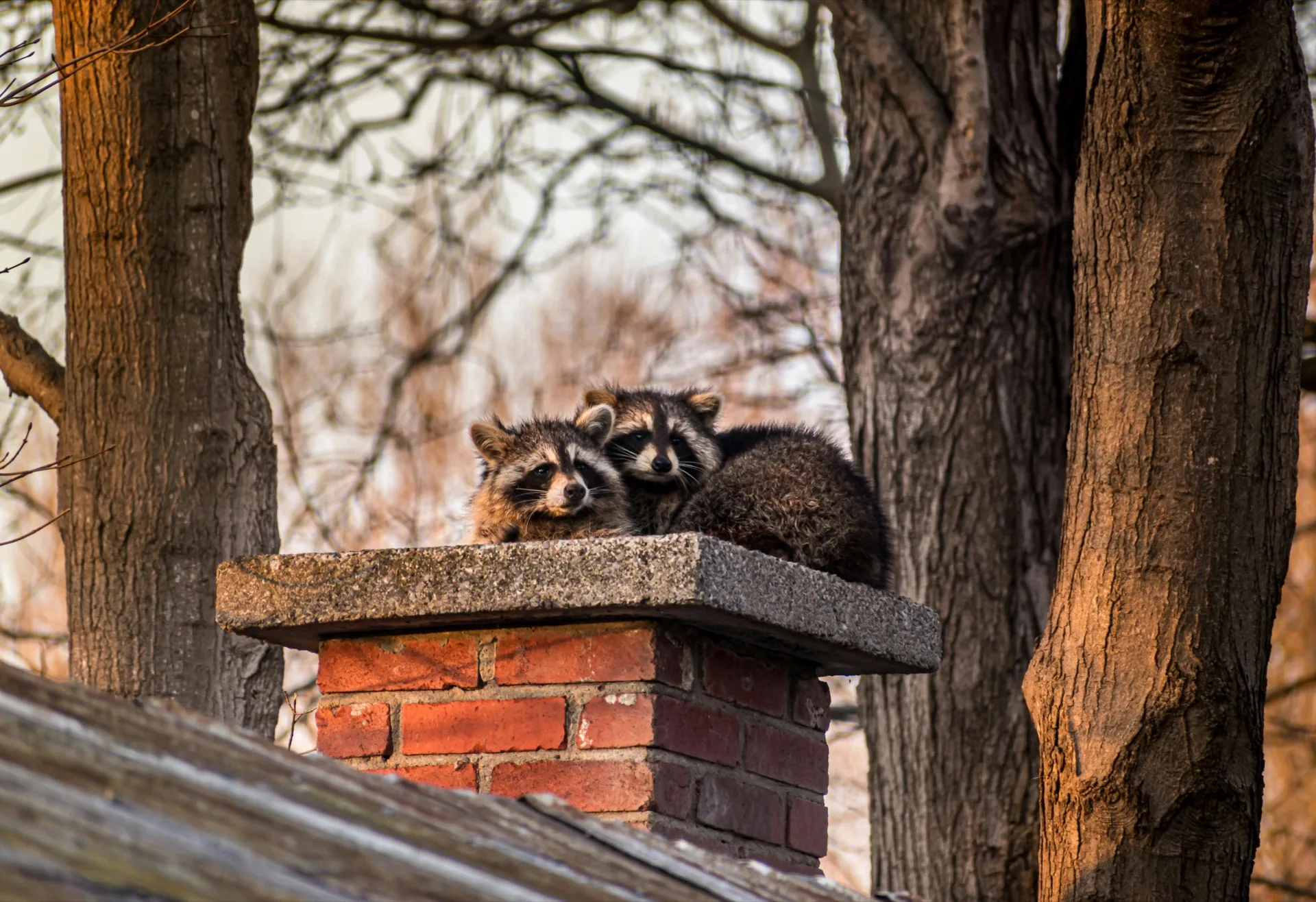
A mother raccoon and her kit on residential brick. Warner Robins raccoons typically enter attics via gable louvers, soffit corners, or attic-fan housings rather than chimneys — but the underlying biology and the late-May timing are the same.
Why Late May Is Peak Raccoon-in-Attic Season in Houston County
Female raccoons den in late winter — typically the second or third week of February through early April in the Georgia Coastal Plain — and the kits are born blind, deaf, and helpless. For the first 6 to 8 weeks the kits stay in the den. They do not vocalize much, they do not move around, and the mother handles all the trips outside for food. Most homeowners during that window do not even know the den is there.
That changes in late May. The kits are now 5 to 10 weeks old. Their eyes are open, their ears work, they are roughly the size of a small kitten, and they have started to move. They climb on each other. They wrestle. They squeal when one of them is being a jerk to the others. That sound — high-pitched chittering and squealing, mixed with the heavier thumping of the mother — is what most Warner Robins homeowners hear first.
The Coastal Plain runs slightly warmer than the Piedmont, which means kit-season timing in Warner Robins is typically one to two weeks ahead of metro Atlanta. By the third and fourth weeks of May, Houston County is at the absolute peak of the call-volume curve. If you are reading this in late May because of something you heard above the ceiling, the timing is not a coincidence — you are hearing exactly what every wildlife company in middle Georgia is hearing on inbound calls right now.
The Robins AFB Buffer Is the Single Biggest Wildlife Source Habitat in Middle Georgia
Warner Robins is a post-WWII city built around Robins Air Force Base starting in 1942. The base sits on the south side of the city and includes approximately 7,000 acres of undeveloped pine-forest buffer around the operational footprint. That buffer is one of the largest contiguous wildlife source habitats anywhere in middle Georgia, and from a residential-raccoon standpoint it changes everything about how the city behaves.
The base buffer continuously disperses raccoons, opossums, fox squirrels, gray squirrels, armadillos, coyotes, and Brazilian free-tailed bats northward into the residential blocks of Warner Robins. Properties on the southern edge of the city — directly adjacent to the base perimeter — absorb the heaviest source pressure in Houston County. Even on the north side of Warner Robins, the AFB buffer is the dominant source population because the dispersal radius is wide.
The practical consequence: Warner Robins raccoon work is rarely a one-and-done capture. Removing the raccoon mother and her kits from a Wellston attic does not solve the underlying problem if the entry point stays open, because the AFB buffer will produce a replacement raccoon within weeks. Full-perimeter exclusion is the only durable approach in this city, and operators who quote you a single-point trap-and-release without exclusion are setting you up for a callback.
Where Raccoons Actually Live in Warner Robins (and What Building Era Matters)
Unlike metro Atlanta or middle Georgia historic-district housing, Warner Robins has essentially zero pre-1900 housing inventory. Everything was built after 1942 to support Robins AFB personnel. That means residential raccoons are almost never in chimneys — they are in attics, and the entry points reflect the construction era of the house.
Wellston and Pleasant Hill (1940s-1970s small-frame post-WWII housing). These are the older central neighborhoods between Watson Boulevard and Russell Parkway. The housing here is now 50 to 80 years old, and the entry-point profile shows it: aged-through galvanized gable vents (original galvanized has typically rusted enough to pull away from the framing), original wood soffits with corner separation at fascia-meet points, and original attic-fan housings that have settled away from their flashing. A typical Wellston home gives a 15-to-25-pound mother raccoon three to five viable entry routes by the time you actually start counting.
1980s-1990s mid-tier subdivisions on the eastern and southern edges. The construction here uses builder-grade vinyl soffits, ridge-vent transitions, and chase-cap details that were perfectly adequate at install but are now 35 to 45 years old. Vinyl-soffit corner separation at fascia-meet points is the dominant failure mode. Ridge-vent flashing has typically failed at one or more end caps. Attic-fan housings — if the house still has one — have aged out of their original tolerances.
2000s-2010s newer-construction subdivisions across northern Warner Robins. The newer stuff has fewer entry points per house (typically 1 to 2 rather than 3 to 5), but the AFB buffer source pressure pushes raccoons hard enough that even newer-construction attics see regular establishment. The exclusion approach is different — fewer points, but each one matters more because the source population is replacing animals on a 30-day cycle.
Lake Joy and Beaverdam Creek shoreline residential (eastern Warner Robins). Houston Lake corridor and Beaverdam Creek tributary feed a secondary shoreline source population on top of the AFB buffer pressure. Lakefront properties run heavier raccoon body weights (the shoreline diet of fish carcasses and crustaceans produces 18-to-25-pound raccoons rather than the 12-to-15-pound buffer-feeders) and correspondingly larger entry damage on whatever soffit or gable they choose.
Centerville and the AFB buffer-adjacent residential (southern edge of city). Properties directly adjacent to the base perimeter absorb the heaviest source pressure in the entire county. Full-perimeter exclusion is the only realistic answer here. Single-point work fails inside of weeks.
How to Tell If You Have Raccoons (vs. Squirrels, vs. Bats) in Your Warner Robins Attic
The species ID matters because the work is different. Here is how to tell what you have:
Raccoon Signs
Thumping and scratching in the attic or above the ceiling, usually loudest at dusk and dawn when the mother is leaving or returning. By late May, also throughout the night and intermittently during the day as kits move around.
High-pitched chittering, squealing, or chirping — kits sound a little bit like a bird with the volume turned up. People often describe it as "crying."
Heavy rustling from the attic space. A 15-pound mother raccoon is not subtle; you hear weight when she moves across the ceiling joists.
A musky smell — distinct from the ammonia-and-dust smell of bat guano. Raccoon urine and droppings have a more "mammal" smell that intensifies in warm weather.
Smudge marks and fur oil staining on siding, brick, or trim immediately below the entry point. The mother grips the same spot on the way in and out for weeks.
Trash-can disruption in the yard that started 2 to 4 weeks ago. Mother raccoons forage harder in late spring because the kits are growing fast.
Squirrel Signs
Scampering or running rather than thumping. Squirrels weigh 1 pound; their sound is light and fast.
Daytime activity, especially mid-morning and late afternoon. Raccoons are nocturnal-crepuscular; squirrels are diurnal.
Chewing sounds — squirrels gnaw on wood framing, insulation, and electrical wire sheathing. Raccoons do not chew structurally.
Two distinct annual breeding waves: late winter (February-March kits) and late summer (July-August kits). Warner Robins has heavy gray squirrel and fox squirrel populations both seasons.
Bat Signs
A whoosh at sunset as the colony emerges from a gable louver, soffit gap, or ridge vent — the most reliable bat-vs-raccoon discriminator. Raccoons do not produce a synchronized dusk emergence; bat colonies do.
Many small high-pitched squeaks in rapid succession (versus the slower, deeper chittering of raccoon kits).
Dark guano accumulating below the entry point that crumbles to dust between your fingers. Raccoon scat stays solid and looks more like a small dog's.
Ammonia smell — sharper and more chemical than the musky smell of raccoons.
Warner Robins bat work is more often Brazilian free-tailed bat (Tadarida brasiliensis) than big-brown, because the Coastal Plain climate and the AFB buffer favor free-tail establishment. Different species, different exclusion timing.
Why You Cannot Simply Trap and Remove the Mother in May
This is the rule that creates the most frustration for Warner Robins homeowners in late May, and I have to be honest about it. If you trap or seal out the mother raccoon while kits are still in the attic, the kits starve to death over the next 5 to 10 days.
What happens next is the part that gets expensive: dead kits in the attic. They decompose. In a Coastal Plain late-May climate that is already 80+ degrees during the day and over 95 in attic spaces, decomposition is fast. Blowflies show up. The smell pushes through the house, especially around HVAC return vents. Recovery means cutting into ceilings or attic floor decking to find the kits one by one, sometimes hidden in soffit boxes or behind insulation. The job that should have been a $700 humane reunion-and-exclusion turns into a $2,500-$5,000 dead-animal-and-drywall remediation job.
The right approach in late May is reunion exclusion:
Identify all the kits in the attic. Typically 3 to 5 kits per litter. They will be in an insulated nest pocket — often near the gable-end or in a soffit box.
Carefully extract the kits using protective gloves and a soft container. They do not bite at this age, but the mother does — so this is timed during the day when she is sleeping elsewhere or out foraging.
Place the kits in a heated, vented reunion box on the roof immediately adjacent to the entry, where the mother can find them.
Install a one-way exclusion device at the active entry that allows the mother to leave but not to re-enter the attic.
The mother returns at dusk, finds the reunion box, picks up the kits one at a time, and relocates them to an alternate den site she has already mapped in her home range. Female raccoons routinely maintain 2 to 4 backup den sites.
Once verified empty (monitored over multiple dusk emergence windows), every viable entry point on the house gets sealed — not just the active one.
That full sequence runs 7 to 14 days. It is more involved than a winter exclusion (when there are no kits and the mother can simply be sealed out). But it is the only humane and durable approach during kit season, and it is the approach that Georgia DNR-licensed operators use.
Why Full-Perimeter Exclusion Matters More in Warner Robins Than Most Cities
Almost every Warner Robins homeowner who has been through a raccoon problem before has hit the same wall: someone trapped a raccoon out of the attic, sealed the obvious entry, and 6 to 8 weeks later the noise was back. That is not a defective trap or a lazy operator. That is the AFB buffer doing exactly what it always does.
In a city where the source population is continuously replenished from a 7,000-acre habitat block, the only durable exclusion approach is identifying and sealing every viable entry point on the entire house. Three to five points on a typical Wellston or Pleasant Hill home. One to two on a newer northern Warner Robins subdivision house. Maybe 6 or more on a larger Lake Joy property with custom architecture.
That work requires a full exterior inspection from grade to ridge — soffit corners, gable louvers, ridge-vent end caps, attic-fan housings, fascia-meet points, brick-veneer separations, dryer-vent terminations, plumbing-vent boots. Every one of them gets evaluated. Every viable one gets sealed in the same job. The materials matter too — galvanized steel cloth and properly fitted vent covers for entry points, not foam-and-caulk for raccoon-grade access.
What a Real Warner Robins Raccoon Exclusion Costs
I am not pricing your specific job, but the scope ranges in Houston County typically run like this:
Wellston, Pleasant Hill, and 1940s-1970s small-frame post-WWII housing: typically $700-$1,800+ for inspection, reunion exclusion in kit season, and full-perimeter sealing of 3 to 5 viable entry points.
1980s-1990s mid-tier subdivisions on the eastern and southern edges: typically $600-$1,500+ for similar scope with vinyl-soffit-grade material and 2 to 4 entry points.
2000s-2010s newer-construction northern Warner Robins subdivisions: typically $500-$1,200+ for tighter entry-point counts (1 to 2) and newer-build exclusion materials.
Lake Joy and Beaverdam Creek lakefront residential: typically $1,200-$2,500+ because of larger property footprints, custom architectural features that produce non-standard entry-point profiles, and the heavier-bodied shoreline raccoons that produce larger entry damage.
AFB buffer-adjacent residential (southern Warner Robins, Centerville): typically $800-$2,000+ because full-perimeter exclusion is the only realistic answer here and the inspection scope is wider.
Dead-kit drywall remediation (after a failed DIY exclusion): $2,500-$5,000+ depending on access scope and how many kits are scattered through the attic and soffit cavities.
Cheaper than that and someone is cutting corners on either the species-handling side (illegal kit separation) or the exclusion side (single-point work that the AFB buffer will defeat in weeks). More than that and you are either dealing with a heavily custom house or you are being overcharged.
Health Concerns: Raccoon Roundworm and Why DIY Cleanup Is a Bad Idea
Baylisascaris procyonis is a roundworm parasite that lives in raccoon intestines and sheds eggs in raccoon feces. Once those eggs are in the environment, they can remain viable in soil and structural debris for years. Human exposure — particularly in children, who put hands in mouths after touching contaminated surfaces — can cause severe neurological disease.
In a Warner Robins attic where raccoons have been denning for two to three months, the latrine site (raccoons designate a corner of the den space as a toilet area) can have significant B. procyonis egg contamination. Disturbing that material without N95+ respiratory protection, gloves, and a HEPA-filtered vacuum system risks both inhalation and dermal-to-oral transmission.
This is the strongest single argument against DIY attic cleanup on a Wellston or Pleasant Hill home: even if the homeowner manages the exclusion safely, the post-job remediation has real public-health stakes that homeowner equipment is not built to handle. Soiled insulation has to come out and be replaced, not vacuumed. Surfaces have to be decontaminated, not just wiped.
If You Hear Something in Your Attic Right Now
The right move in late May is not to wait. Kits are growing 50-100 grams per day at this stage. By the second week of June they will be roughly 2 pounds each, mobile enough to follow the mother on short trips outside, and starting to scatter through the attic. Reunion exclusion gets harder once kits are old enough to move on their own. The window between now and roughly the second or third week of June is the cleanest time to handle this.
If you live in Warner Robins, Centerville, Bonaire, Kathleen, or anywhere in Houston County and you are hearing thumping or chittering above the ceiling: get a licensed wildlife operator out for an inspection this week. Make sure they are licensed under Georgia DNR Wildlife Resources Division (Houston County falls in DNR Region 4), make sure they understand AFB-buffer source dynamics and full-perimeter exclusion specifically, and make sure they are not promising to "just trap the raccoon" without addressing every viable entry point on the house.
The pattern across Houston County is consistent, and the right answers in May are the same anywhere it shows up: reunion exclusion during kit season, full-perimeter sealing of every viable entry, proper Baylisascaris-aware post-job remediation, and patience with the 7-to-14-day timeline that doing it correctly actually requires. Find a Georgia DNR-licensed operator who is active in Houston County and who understands the AFB-buffer source pressure, and the problem is solvable inside two weeks.
Get Connected With a Licensed Wildlife Removal Pro
Skip the research — call our 24/7 dispatch line for an immediate connection.
Justin McCalvin has spent 11 years in licensed wildlife removal — much of it on attic-entry exclusion work across central and south Georgia residential housing. Licensed under Georgia DNR Wildlife Resources Division.
Frequently Asked Questions
Why are raccoons in attics such a problem in Warner Robins during May?
+
Female raccoons den in attic spaces February through April to give birth and raise kits. By late May the kits are 5 to 10 weeks old, mobile, and vocal — that is when most Wellston, Pleasant Hill, Lake Joy, and northern Warner Robins homeowners first hear the noise. The Robins AFB buffer on the south side of the city continuously replenishes the residential raccoon population from a 7,000-acre source habitat, which concentrates kit-season activity across the entire Houston County housing inventory.
Can I just trap the raccoon and seal up the entry myself?
+
No, not in May. Trapping or sealing out the mother while kits are still in the attic causes the kits to starve, and the resulting decomposition produces a far worse problem (odor, blowflies, drywall-intrusive recovery work). The correct approach during kit season is reunion exclusion: extract the kits, place them in a heated reunion box near the active entry, install a one-way valve so the mother can leave but not re-enter, and let her relocate the kits to one of her backup dens. Once verified empty, every viable entry on the entire house gets sealed.
How much does raccoon removal cost in Warner Robins?
+
Wellston and Pleasant Hill 1940s-1970s small-frame jobs typically run $700-$1,800+ for reunion exclusion plus full-perimeter sealing of 3 to 5 entry points. 1980s-1990s mid-tier subdivision jobs run $600-$1,500+. 2000s-2010s newer northern Warner Robins subdivisions typically run $500-$1,200+ because there are fewer entry points. Lake Joy lakefront properties run $1,200-$2,500+ because of larger footprints and heavier-bodied shoreline raccoons. AFB buffer-adjacent properties run $800-$2,000+ because full-perimeter inspection scope is wider.
Why does the Robins Air Force Base buffer matter for my raccoon problem?
+
The base sits on the south side of Warner Robins and includes approximately 7,000 acres of undeveloped pine-forest buffer around the operational footprint. That buffer is one of the largest contiguous wildlife source habitats in middle Georgia, and it continuously disperses raccoons northward into the residential blocks of Warner Robins. In practice, this means single-point trap-and-release work fails inside of weeks because the source population is constantly replenished. Full-perimeter exclusion of every viable entry point on the house is the only durable answer.
Is raccoon waste in my Warner Robins attic a real health risk?
+
Yes. Raccoons carry Baylisascaris procyonis, a roundworm whose eggs can remain viable in environmental contamination for years and can cause severe neurological disease in humans (particularly children) on accidental ingestion. Multi-month attic use produces measurable contamination at the latrine site. Cleanup requires N95+ respiratory protection, gloves, HEPA-filtered vacuum, and replacement of contaminated insulation — homeowner DIY equipment is not adequate.
How do I tell if I have raccoons versus squirrels versus bats in my Warner Robins attic?
+
Raccoons produce heavy thumping, slow chittering, and dusk-and-dawn activity from a single mother — sometimes accompanied by kit squealing in late spring. Squirrels are diurnal, light, fast-moving, and often chewing on framing or wire sheathing. Bats produce a synchronized whoosh emergence at sunset from a gable louver or soffit gap, plus many small high-pitched chirps. The single most reliable test is standing outside at dusk on a clear evening and watching the roofline: bats emerge in numbers, raccoons produce a single mother climbing slowly out 30-45 minutes after sunset, and squirrels typically do not emerge (they are already inside for the night).
How do I find a licensed raccoon removal pro in Warner Robins?
+
Warner Robins raccoon work needs a Georgia DNR-licensed operator active in Houston County (DNR Region 4) who specifically understands Robins AFB-buffer source dynamics and full-perimeter exclusion. The non-negotiables: current Georgia DNR licensing, demonstrated willingness to identify and seal every viable entry on the house (not just the obvious one), proper reunion exclusion during kit season instead of a flat-rate seal-up shortcut, and PPE protocols for Baylisascaris contamination during post-exclusion cleanup. This directory connects homeowners with the licensed operator who covers Houston County.