Baby Squirrel Season in Fayetteville, GA — A Wildlife Pro's Guide
Every February in Fayetteville my phone starts ringing with the same call. Eastern gray squirrels are whelping in attics, and the timing of what you do next matters more than most homeowners realize.
By Justin McCalvin
Every February my phone starts ringing in Fayetteville. About mid-month, homeowners start hearing the same thing — fast, light running across the ceiling in the late afternoon, plus a sound like somebody up there with a Dremel. That's Eastern gray squirrels (Sciurus carolinensis) settling into nest sites. A few weeks after that, somebody's got pups born above their bedroom.
I've been doing wildlife work across north Georgia for 11 years, and Fayette County is part of that coverage. Local Wildlife Experts is our family business, and from February through May — then again August through October — squirrel calls fill the schedule. What you do in the next few days after you start hearing them matters. A lot of homeowners get it wrong, and it costs them.
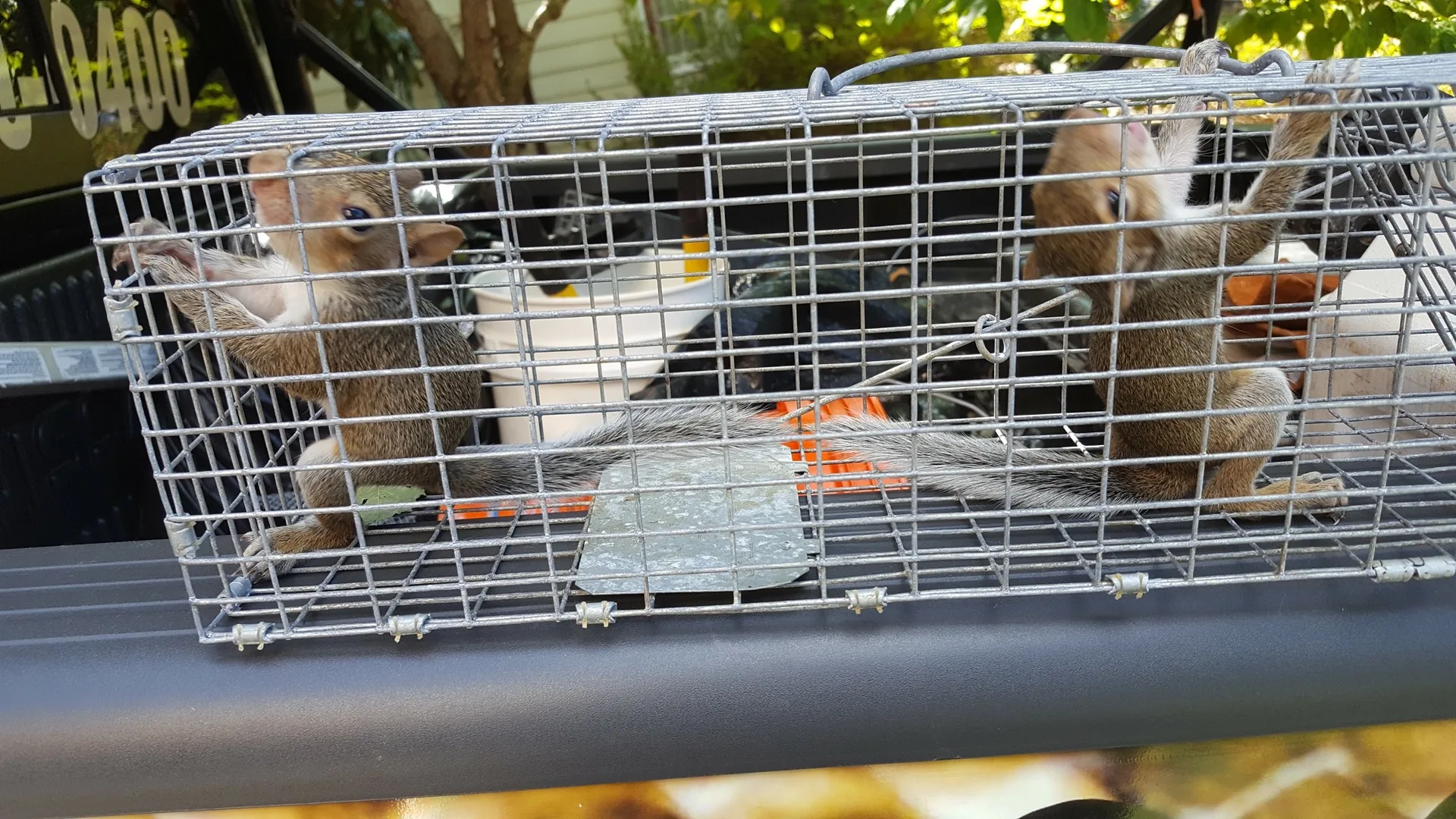
Two juvenile Eastern gray squirrels (Sciurus carolinensis) in a humane live trap from a Fayetteville baby squirrel removal — both released back to suitable wild habitat once the family was safely excluded from the homeowner's attic.
Why Fayetteville Has More Squirrels Than You Notice
Fayetteville's residential canopy is one of the most mature in south-metro Atlanta. The pre-1900 historic-downtown blocks around the Fayette County Courthouse have housing stock with original soffits, gable louvers without screen backing, and oak-hickory canopy that has been growing for 80-plus years. The mid-century neighborhoods between downtown and the South Fayette schools follow a similar pattern at smaller scale. Even newer subdivisions on Fayetteville's northern and eastern edges have reached canopy maturity that supports continuous gray squirrel populations.
The unbroken canopy is the part most homeowners miss. Squirrels do not need to touch the ground to move between properties — they use tree-to-roof bridges, then roof-to-tree-to-roof bridges. A gray squirrel can travel across an entire Fayetteville neighborhood without ever being on the ground. That continuous habitat is why properties keep getting re-infested even after a single entry point is sealed.
One detail that surprises homeowners: Eastern gray squirrels are diurnal. Peak activity is early morning and late afternoon. That's when most homeowners first hear scratching from the ceiling — and it's the single clearest signal that what you have overhead is squirrels, not rats.
The Squirrel Calendar — Why Spring Is Different
Eastern gray squirrels in Georgia have two distinct breeding cycles per year:
First litter — born late February through early April. Pups are blind and immobile for the first 4-6 weeks, fully weaned and dispersing by late May or early June.
Second litter — born August through September. Pups are blind and immobile for 4-6 weeks, fully weaned and dispersing by late October or early November.
That schedule produces twin call peaks every year. February through May is the spring peak — the calls I'm getting right now. August through November is the fall peak.
Here's where it goes wrong. The do-something-now instinct kicks in, and that instinct is exactly the wrong call during the kit period. From the moment pups are born until they can move on their own is a 6-to-8-week window. Any exclusion work in that window — sealing the entry, deploying one-way doors, even disturbing the nest — cuts the mother off from immobile pups. The pups die in the wall void. Now we're not doing squirrel exclusion in Fayetteville anymore. We're cutting drywall, pulling out carcasses, replacing insulation, and decontaminating.
I see this every spring. Every single one of these is preventable. Two or three times a year I get called to a Fayetteville house where somebody didn't wait, and now they've got a much bigger problem.
How to Tell You Have Baby Squirrels in Your Fayetteville Attic
Here's what to listen and look for:
Scampering at dawn and late afternoon — gray squirrels are diurnal. Daytime activity overhead is a much stronger squirrel signal than nighttime activity.
Quick, light footfall sounds — much lighter than raccoons, faster than rats. Homeowners often describe it as "running."
Chewing or gnawing sounds — squirrels chew constantly to keep their incisors filed. You'll hear it through the ceiling.
Nest material in the attic — leaves, insulation, paper, and shredded fabric bundled in a corner near the entry. If you've safely peeked in and see a softball-sized bundle, that's a nest.
High-pitched chittering — pups vocalize. The sound is distinct from adult chatter and is the clearest single signal that a litter has been born.
Rice-grain-sized droppings — clustered in the nest area or along travel routes.
Damaged fascia or soffits with chewed openings — the active entry, often visible from the ground.
If you're seeing or hearing several of these together during February-April or August-September, do not seal the entry yet.
Why Spring Eviction Almost Always Goes Wrong
Here's the scenario I see every spring in Fayetteville. The homeowner watches an adult gray squirrel come in and out of the soffit a few times. They climb up with hardware cloth or a tube of caulk, seal the gap, and move on with their day.
About two weeks later, the smell starts.
The adult was a nursing mother. Her four-to-five pups were already inside the attic, nested behind insulation. Once the entry was sealed, the mother couldn't get back in to feed them. The pups starved over a few days, died in the nest, and decomposition started. Blowflies show up within 24-48 hours of death and lay eggs that hatch into maggot infestations. Within a week the smell is coming through the ceiling drywall into the bedroom below.
So now we're doing dead-animal recovery in a Fayetteville home — locating the carcasses by following the smell through the ceiling, cutting drywall open, pulling the nest and the pups, decontaminating insulation, and patching everything back. I see this every spring across Fayetteville and the rest of the Atlanta-metro suburbs. It's the most preventable mistake in baby squirrel season, and it's also the most common.
The Two Safe Windows for Squirrel Removal in Fayetteville
Squirrel exclusion only really works in two narrow windows each year:
Late May through early June — after first-litter pups have dispersed. By that point the young squirrels are out moving on their own. One-way doors go in during this window, and structural sealing follows once we've confirmed everyone is out.
Late October through November — after second-litter pups have dispersed.
Inspection and entry-point identification can happen any time. That's what we usually do during kit season — get out to the Fayetteville property, map every viable entry, document the active one, and put the actual exclusion work on the calendar for the next safe window. Homeowner isn't waiting blind, and we've got a plan ready to go the day the window opens.
The other thing we do during kit season is check the property for chewed wiring. I'd rather know about chewed Romex before pups emerge than find it after.
Chewed Wires — The Real Hidden Risk
Squirrels chew wires reflexively. They aren't targeting the wiring — they're filing their incisors, which grow continuously. But Romex is right there, and they cannot tell the difference between wire jackets and structural wood.
Chewed Romex is documented as a leading cause of attic-origin residential fires. The risk is amplified in Fayetteville's pre-1900 historic-downtown housing where wiring runs are 60-100+ years old (early Romex, knob-and-tube remnants, undersized neutrals). Even modern Romex in the 1990s-2010s subdivisions shows chew damage at cable, AC-line, and dryer-vent penetrations after sustained squirrel activity.
Any squirrel exclusion job that exposes chewed wiring requires licensed-electrician follow-up before final sealing — both for safety and to satisfy homeowners' insurance underwriters. We document chewed wiring during the kit-season inspection so the homeowner knows the actual scope before exclusion begins, and so there are no surprises during the safe window.
When to Call
Call us when you're hearing scampering or chewing from the ceiling in February-April or August-October, when you see an adult gray squirrel coming in and out of your roofline, when you find chewed openings in your fascia or soffit, or when you find rice-grain-sized droppings in the attic.
Same-day inspections are usually available across Fayetteville, Peachtree City, Tyrone, and the rest of Fayette County. If you'd like to see how we handle the work, here's our Fayetteville squirrel removal page and the broader Georgia squirrel work hub. For another seasonal-timing read, our Douglasville bat exclusion guide covers the same calendar logic for a different species.
What I Tell Every Fayetteville Homeowner Who Calls During Baby Squirrel Season
Eleven years in, the message hasn't changed: do not seal the entry yet. Get an inspection, get a plan, and do the actual exclusion in the right window. We can pull squirrels out of an attic. We can repair the attic. We can replace chewed wiring. The one thing we can't undo is pups starving inside your wall.
If you've got squirrels in your Fayetteville attic — or you think you might — call (844) 544-3498 and we'll get out there.
— Justin McCalvin, Local Wildlife Experts
Get Connected With a Licensed Wildlife Removal Pro
Skip the research — call our 24/7 dispatch line for an immediate connection.
Justin McCalvin works with Local Wildlife Experts, a family-run wildlife removal company that covers all of north Georgia. He has spent 11 years in the field and is licensed under Georgia DNR Wildlife Resources Division.