Raccoon Removal in Bartlett
Local licensed expert serving Bartlett and all of Shelby County. Raccoons cause serious attic and crawlspace damage and carry diseases including rabies and roundworm.
📞 Call (844) 544-3498Raccoons in Bartlett, Tennessee
Northern raccoons (Procyon lotor) are the highest-volume residential intrusion call across Bartlett, with the heaviest pressure on the established 1960s-80s housing of Bartlett Station, Stage Hills, Ellendale, and Davies Plantation where 50+ years of soffit, fascia, and vent-screen weathering have produced a textbook entry-point inventory at almost every residential address. The Loosahatchie River corridor on the city's north side delivers raccoons, opossums, and skunks directly into the north-Bartlett residential blocks. The Stage Road commercial corridor produces sustained dumpster-driven raccoon activity that spills into adjacent residential blocks overnight. Mature established landscaping — original 1960s-70s plantings now grown in to canopy density — provides continuous travel routes between properties.
Raccoon Removal — Bartlett, Tennessee
Licensed local expert. Same-day and emergency service in Bartlett.
Serving Bartlett and all of Shelby County, Tennessee
Raccoon Removal in Bartlett — What to Expect
Raccoons breed in attics and their feces carry dangerous roundworm spores. Fast removal is essential.
Signs You Have Raccoons
Raccoons are active year-round but most commonly enter homes in late winter and spring when females seek nesting sites.
- Noises in attic at night
- Knocked over trash cans
- Torn soffit or fascia boards
- Droppings near entry points
- Footprints in mud or soft soil
Our Process in Bartlett
Our local Shelby County contractor serves all of Bartlett using the same proven, humane process for every job.
- Live trapping and removal
- Attic cleanup and decontamination
- Entry point sealing
- Damage repair
- Preventative exclusion
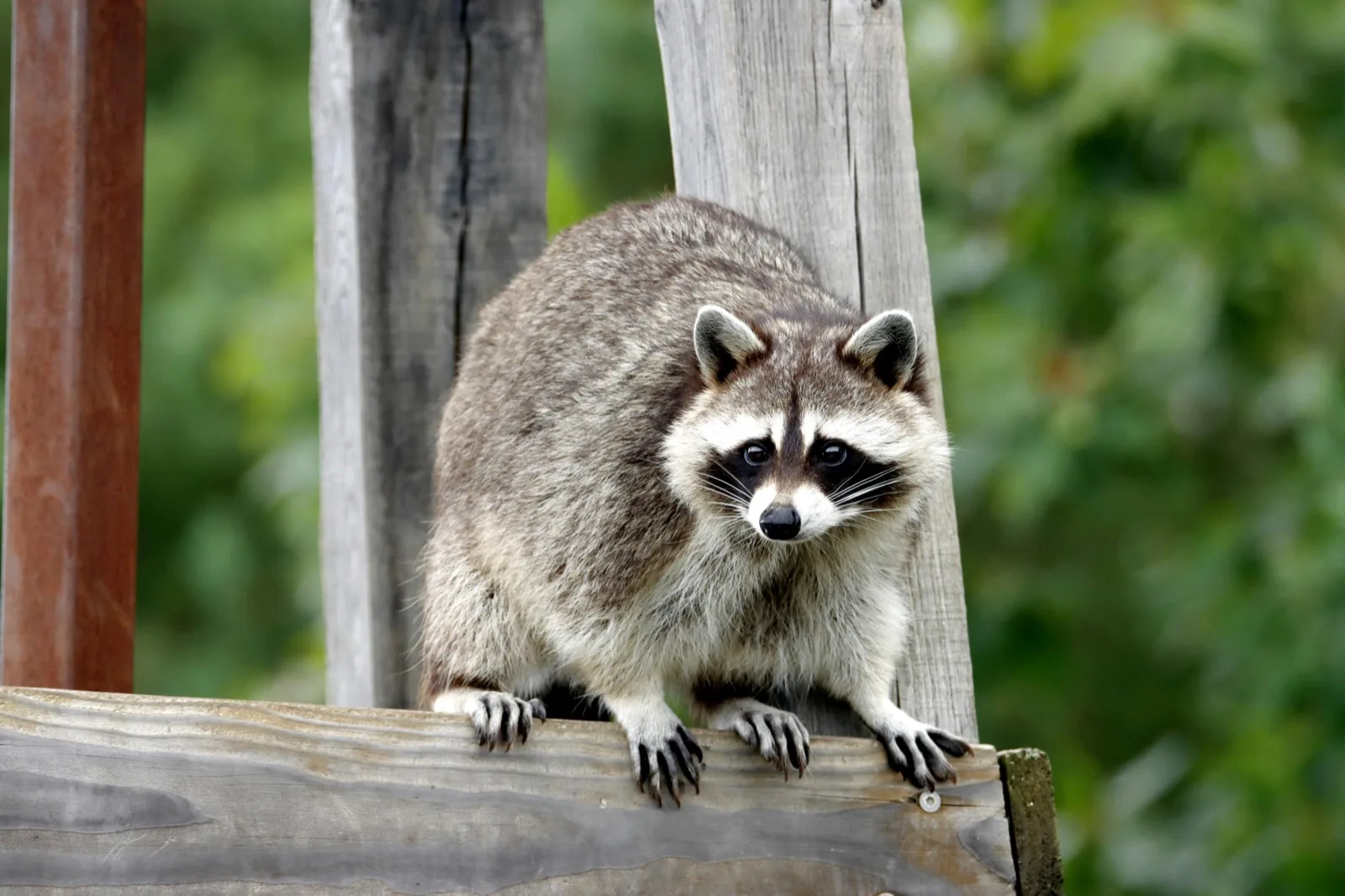
Three Bartlett-specific drivers stack to put raccoons inside Bartlett homes year after year. The 1960s-80s housing stock across Bartlett Station, Stage Hills, Ellendale, the older Davies Plantation blocks, the Bartlett Road / Yale Road corridor, and the inner Stage Road residential edges presents an entry-point profile that's fundamentally different from newer suburban construction: aging original wood soffits with corner separations and miter-joint failures from 50+ years of weathering, weathered fascia boards with grain loss and edge-gap openings at the fascia-to-soffit junction, deteriorated original gable-vent screens (50+ year aluminum or galvanized screening that has torn, peeled, or rusted through), original chimney-cap and crown details that have aged out of integrity, original attic-fan housings with seal failures at the housing-to-roof interface, and the brick-veneer weep-hole and slab-edge gaps standard in mid-century suburban construction. Per-property entry-point counts on Bartlett's older inventory commonly run 5-8 viable raccoon entries per home — meaningfully higher than newer construction supports — because the aging materials simultaneously open multiple access paths along the soffit, fascia, and vent inventory rather than failing at one point. The Loosahatchie River corridor on Bartlett's north side delivers a continuous nightly load of dispersing raccoons, opossums, and skunks into the north-Bartlett residential blocks (the upper Bartlett Boulevard frontage, the Yale Road north-side residential edges, and the Davies Plantation blocks backing onto the river floodplain). The Loosahatchie's bottomland forest holds a permanent raccoon population that disperses south into the residential interior on every nightly forage. The Stage Road commercial corridor — Bartlett's primary food-and-beverage strip — produces sustained dumpster-driven raccoon activity that spills into the adjacent Bartlett Station, Stage Hills, and Ellendale residential blocks overnight. Restaurant alley-and-loading-dock infrastructure, the older retail-strip dumpster pads, and the gas-station and convenience-store food-waste sources along Stage Road support a steady-state raccoon population that uses the residential blocks as denning territory while foraging on the commercial corridor.
Bartlett's housing stock then transforms that wildlife pressure into a specifically aging-materials exclusion problem. The dominant inventory is 1960s ranch and split-level construction across the Bartlett Station core, the Ellendale historic blocks, and the inner Stage Hills streets — brick-veneer-on-frame construction with vented crawlspaces or slab-on-grade foundations, asphalt-shingle roofs, original aluminum-clad windows, attached single- or two-car garages, and the modest hipped-or-moderate-gable rooflines characteristic of early-suburban West Tennessee work. The 1970s-80s wave across the outer Bartlett Station, the Stage Hills outer streets, and the early Davies Plantation blocks adds slightly more complex rooflines, dimensional-shingle replacement on a share of the inventory, and the era's standard suburban architectural detail. The late-1980s build-out at outer Davies Plantation introduces vinyl-clad windows and the slightly tighter envelopes of late-twentieth-century construction. Across all three eras the constants are original wood soffits and fascia that are now 40-60 years into the weathering cycle, original gable-vent and attic-fan-housing inventory that has aged 40-60 years past its installed life, and the standard mid-century brick-veneer entry-point vocabulary at slab-edge weep holes and foundation-to-veneer gaps. The contractor's Bartlett inspection identifies the era-specific weathering signatures on each property and maps every viable entry rather than the single visible entry the homeowner has noticed.
Mature established landscaping compounds the entry pressure on Bartlett's older blocks. Original 1960s-70s plantings — water oak, willow oak, sweet gum, pin oak, magnolia, and the silver maples and Bradford pears that were standard suburban specimens of the era — are now 50-60 years grown in across Bartlett Station, Ellendale, and the inner Stage Hills streets. Continuous canopy on these blocks gives raccoons roof-to-roof travel routes that don't depend on the descent-and-cross pattern they need on more sparsely-canopied newer subdivisions. The same homes generate raccoon calls year after year because the entry-point inventory is structural to the housing stock and the surrounding canopy keeps fresh raccoons cycling through. Younger Davies Plantation properties on the outer blocks have less mature canopy and generally less entry-point pressure per home, but the housing-stock entry vocabulary catches up with age — properties built in the late-1980s outer Davies Plantation blocks are now starting to show the soffit-and-fascia weathering signatures that drive call volume on the older inventory.
Inside the structure, Bartlett attic volumes (commonly 1,000-1,800 square feet of accessible interior on the 1960s-70s ranch belt and 1,200-2,200 square feet on the 1980s split-level and Davies Plantation housing) accommodate sustained multi-year raccoon occupancies that produce substantial insulation contamination. A raccoon family inside a 1,500-square-foot Bartlett Station attic can foul the entire insulation footprint with urine and roundworm-spore-bearing feces, contaminate HVAC ductwork that runs through unconditioned attic space (a real issue in 1960s-80s Bartlett construction where ducts run the full attic length on slab-foundation housing), gnaw electrical wiring at multiple points, and leave damage at multiple soffit-corner and fascia-edge entries simultaneously. The contractor's standard Bartlett raccoon scope covers full attic decontamination across the affected footprint, contaminated insulation removal and replacement, raccoon-roundworm-effective structural disinfection of joists and decking, HVAC duct disinfection or replacement where ductwork has been compromised, structural exclusion of every entry point identified across the 5-8 viable entries typical on an older Bartlett property, and partnered fascia-and-soffit restoration where 40-60 years of weathering require board replacement rather than simple sealing.
Raccoon Entry-Point Profile by Bartlett Housing Era
Bartlett's 1960s-80s housing stock presents a distinctive entry-point inventory the contractor maps on every inspection. Aging original wood soffits on the 1960s-70s ranch belt across Bartlett Station and Ellendale develop corner-separation gaps and miter-joint failures at the fascia-to-soffit junction after 40-60 years of weathering — these are the most common single-point raccoon entries on Bartlett's older inventory, and the entry signature is a separated soffit panel with claw marks at the fascia edge and visible insulation through the gap. Weathered fascia boards on the original construction have grain loss and edge-gap openings at miter joints, particularly at the front-gable / side-elevation intersection where two fascia boards meet at a corner — the resulting gap admits raccoons into the soffit cavity. Deteriorated original gable-vent screens on the 1960s-80s housing carry 40-60 year old aluminum or galvanized screening that has torn, peeled, or rusted through; raccoons enter directly through the screen failure with minimal additional damage. Original attic-fan housings on the 1960s-70s housing fail at the housing-to-roof seal after 40-60 years of weathering; raccoons exploit the gap and enter directly above the fan motor, often nesting in the housing itself. Original chimney-cap and crown details on the 1960s-70s brick chimneys have weathered out of integrity; uncapped or partially-capped flue terminations admit raccoons into the chimney chase for winter denning and February-April whelping. Brick-veneer weep holes on slab-foundation housing without modern screening admit opportunistic raccoons at slab elevation, particularly when garage entries or basement access is compromised on properties with attached or detached garages. Garage-door bottom seals on the older inventory have aged out of integrity, and the gap between the garage-door bottom and the slab admits raccoons into the garage, from which they access wall-cavity entries to the main residence.
Stage Road Commercial Corridor and Adjacent-Residential Pressure
Stage Road is Bartlett's primary food-and-beverage strip, and the commercial corridor's dumpster-driven raccoon activity is a direct driver of residential call volume in the immediately adjacent Bartlett Station, Stage Hills, and Ellendale blocks. Restaurant alley-and-loading-dock infrastructure behind the Stage Road retail strip, the older retail-pad dumpster locations, the gas-station and convenience-store food-waste sources along the corridor, and the fast-food restaurant pad sites all support a steady-state raccoon population that uses the residential blocks behind the corridor as denning territory while foraging on the commercial side overnight. Properties on the inner Stage Hills, the south-Bartlett-Boulevard corridor, and the Ellendale streets adjacent to Stage Road see fresh raccoon arrivals year-round with peak pressure during juvenile dispersal in August-October. The contractor's inspection scope on these properties addresses both the residential-side entry-point sealing and, where the issue is community-wide, food-source pressure reduction by the commercial-side property owners through dumpster-management and exclusion-fencing recommendations. Single-property exclusion is durable on the property itself, but corridor-driven entry attempts continue each season — which is why the Bartlett work emphasizes structural sealing of every viable entry rather than relying on the residency of the current occupant being temporary.
Loosahatchie River Corridor and North-Bartlett Direct Delivery
The Loosahatchie River runs along Bartlett's northern boundary, and the river's bottomland forest is a continuous wildlife corridor that delivers raccoons, opossums, and skunks directly into the north-Bartlett residential blocks. Properties along the upper Bartlett Boulevard frontage, the Yale Road north-side residential edges, the Stage Road north-side blocks, and the Davies Plantation properties backing onto the river floodplain receive direct corridor-driven raccoon pressure year-round. The Loosahatchie corridor at Bartlett is narrower than the Wolf River at Germantown and carries less total bottomland-forest acreage, but the proximity is closer — north-Bartlett properties commonly back directly onto the river-bottomland forest with no intervening greenway buffer, which means the raccoon delivery from the corridor lands at the property line rather than dispersing across a greenway transition. Juvenile dispersal in August-October pushes the heaviest fresh-raccoon load through the corridor each year, and the contractor's seasonal pressure mapping on north-Bartlett properties accounts for both the spring kit-rearing pressure and the fall dispersal pulse. The corridor's secondary species delivery — opossums (heavy denning under decks and porches across the older Bartlett housing) and striped skunks (denning under sheds and crawlspaces, with discharge events near home foundations producing odor-remediation calls) — is documented at higher density on north-Bartlett properties than on the southern half of the city.
Roundworm Spore Biology and Why Bartlett Latrines Matter
Raccoon roundworm (Baylisascaris procyonis) eggs shed in raccoon feces survive in the environment for years, are resistant to most household disinfectants, and can cause severe and sometimes fatal larva-migrans disease in humans, dogs, and cats — particularly in children. Raccoons establish latrines (concentrated defecation sites) inside attics, on flat roof sections, in tree forks, on woodpile tops, and on stone garden walls. Inside a typical Bartlett 1,000-1,800 square foot attic, a multi-month or multi-year raccoon occupancy commonly establishes two to four distinct latrines across the footprint, with sustained occupancies on aging-housing-stock properties often producing larger total guano accumulation than newer-construction occupancies because the attic conditions support multi-year tenure. Standard remediation requires identification, manual removal under PPE protocol, and structural disinfection at every latrine site using elevated heat (130°F+ steam) or specific chemical agents (concentrated bleach, certain quaternary ammonium compounds at extended contact time) — typical household cleaners are not effective. The contractor's Bartlett remediation scope addresses each latrine site as a separate work zone with proper PPE, containment, and disposal protocol, with documentation provided for insurance claims and homeowner records.
The Bartlett Raccoon Calendar
Raccoon pressure in Bartlett runs twelve months a year and follows the same compressed West Tennessee cycle as Germantown and Collierville. January-February: Adult female den-scouting concentrates on aging soffit corners, weathered fascia gaps, and original chimney-cap failures across Bartlett Station, Ellendale, and the inner Stage Hills 1960s-70s housing — pre-natal trapping during this window is the most efficient adult-removal opportunity. Stage Road commercial corridor pressure is sustained year-round with a slight increase as raccoons seek warmer den sites during cold snaps. February-April: Kit-rearing peak — slightly earlier than middle Tennessee. Direct trapping during this window risks separation outcomes inside the older Bartlett attic volumes; the contractor's spring-window scope is recovery-and-extraction protocol followed by exclusion once kits are mobile. April-June: Loosahatchie corridor delivery peaks as kits emerge from aging-stock attic dens and adult females teach foraging along the north-Bartlett property-line bottomland — exclusion windows reopen mid-window. June-August: Family group dispersal. Inspection demand peaks as homeowners discover damage to aging soffits and fascia. August-October: Juvenile dispersal — the season's largest population is now mobile and seeking new den sites. Stage Road corridor-driven pressure peaks as juveniles disperse from commercial-side den sites into the residential blocks. Aging-soffit and aging-fascia sealing is heaviest during this window in advance of winter denning. November-January: Pre-winter denning consolidations — multiple raccoons sometimes share a single Bartlett attic for warmth in the older Bartlett Station and Ellendale housing where original chimney and gable-vent construction has aged out of integrity, and the consolidations frequently include opossums sharing the same attic spaces.
What to Expect on a Bartlett Raccoon Job
The standard sequence on a confirmed in-attic raccoon occupancy in Bartlett runs roughly: Day 1 — full inspection (interior attic walk, exterior roof walk with particular attention to aging-soffit corners, weathered-fascia miter joints, deteriorated gable-vent screening, original attic-fan housings, and chimney-cap-and-crown integrity), entry-point identification across the typical 5-8 viable entries on older Bartlett housing, species and reproductive-status assessment, kit-presence determination, written scope and pricing. Days 2-7 — adult removal under TWRA Region I rules using species-specific traps positioned at active entry points; on confirmed kit presence, recovery-and-extraction protocol with daily site visits. Days 8-14 — elevated attic decontamination scope reflecting the larger guano accumulation typical of multi-year aging-stock occupancies: insulation removal across the affected footprint, structural disinfection of joists, decking, and the older 1960s-70s rafter framing, HVAC duct disinfection or replacement on the unconditioned-attic ductwork standard in slab-foundation Bartlett construction, latrine-site treatment under 130°F+ steam protocol, contaminated material disposal under regulated-waste protocol. Days 14-21 — partnered fascia-and-soffit restoration where 40-60 years of weathering require board replacement rather than simple sealing; gable-vent screen replacement using galvanized steel mesh; chimney cap-and-crown installation; attic-fan-housing seal restoration; brick-veneer weep-hole screening; garage-door bottom-seal replacement where applicable. Day 21+ — final inspection plus aging-stock follow-up monitoring at 30 and 60 days because aging-housing-stock infestations carry higher recurrence risk (more entry points, more failure points, and the same canopy travel routes still pushing fresh raccoons across the property line). Most Bartlett raccoon jobs complete in two to three weeks of total elapsed time on standard occupancies; multi-year infestations on the older Bartlett Station and Ellendale housing with full fascia-and-soffit restoration may extend to four weeks because of the carpentry-trade scheduling.
⚠️ Peak Juvenile Dispersal — Highest Annual Call Volume
August through November is the absolute peak for raccoon attic, chimney, and outbuilding calls. Juveniles leaving natal dens seek their own territories, and any home with even small exclusion gaps sees new intrusions within days. Same-day inspection strongly recommended.
Raccoon Removal Cost in Bartlett
$200–$600+
Trapping and removal. Attic cleanup and exclusion additional ($800–$2,500+). Call for an estimate — pricing varies by contractor and job complexity.
Frequently Asked Questions — Raccoon Removal in Bartlett
More Wildlife Services in Bartlett
Your local contractor handles all wildlife removal needs